
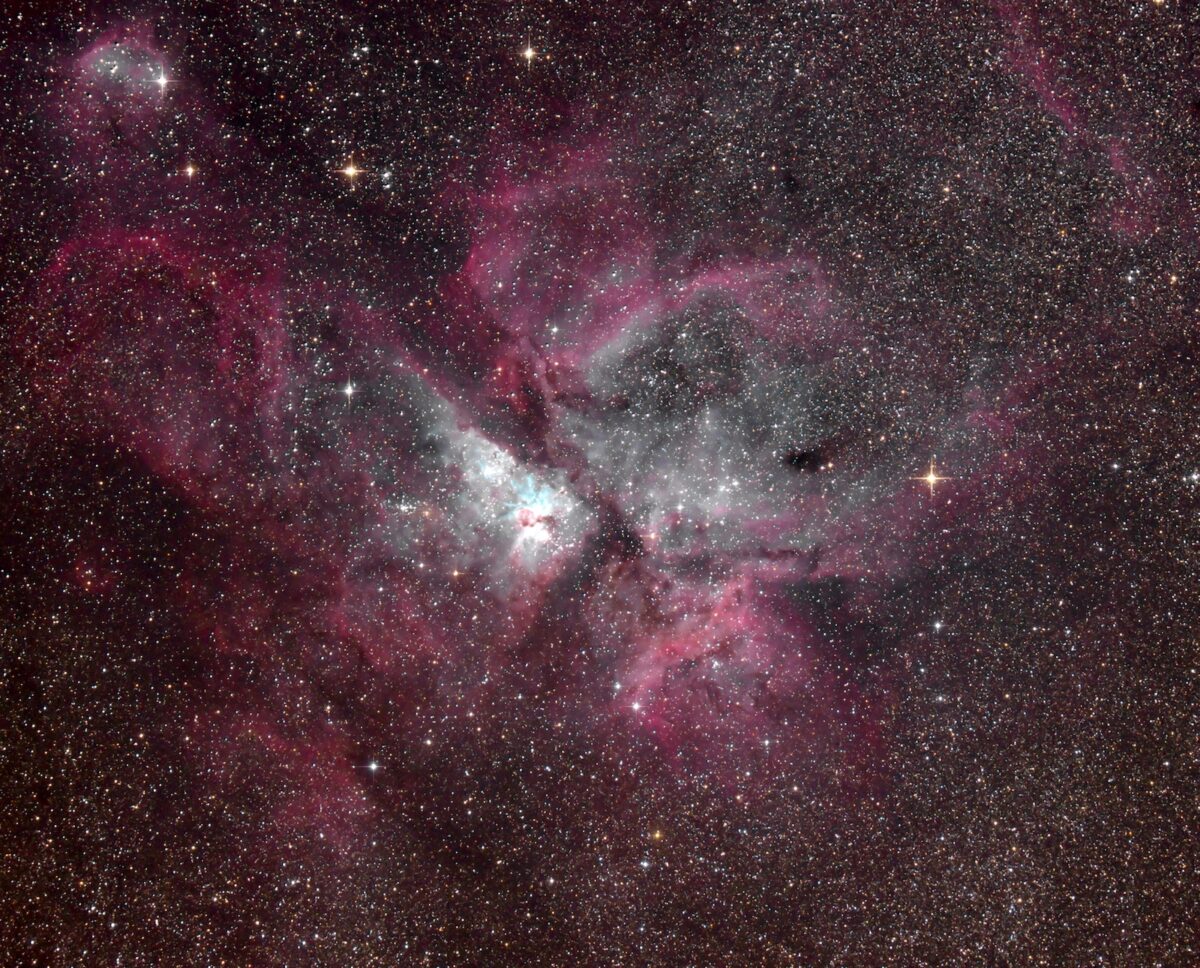
NGC 3372, the Carina Nebula, is a large, complex area of bright and dark nebulosity in the constellation Carina, and is located in the Carina-Sagittarius Arm. Also known as the Eta Carinae Nebula, it lies between 6500 and 10,000 light-years from Earth. Photo: MPAS member Ben Claringbold
Highlights this month
- 4FriMercury is stationary — resumes direct (eastward) motion. (9:17am)
- 5SatSaturn in superior conjunction with the Sun — lost in the glare. (5:55am)
- 17ThuMercury at greatest morning elongation (26° from the Sun, mag 0.0) — best morning apparition. (8:01am)
Looking north, in the constellation Cancer, the Crab, look out for the wonderful star cluster M44, also known as the Beehive Cluster or Praesepe. Easy to locate, it sits at the very centre of the constellation, close to the stars Gamma (γ) and Delta (δ) Cancri. M44 appears as a misty patch to the unaided eye from a dark sky location, and as a glittering collection of stars though binoculars. Also on show, and best seen with a telescope, are the interesting spiral galaxies M65 and M66 in Leo, the Lion. These galaxies appear as elliptical smudges though a telescope.
This is a good time to observe and admire the rich star fields of the Milky Way stretching across the southern skies. To scan these stars, you only need your eyes or a pair of binoculars. Look out for the Milky Way running through the constellations Crux, Centaurus, Musca, and Carina in the east. Be sure to observe the Coalsack Nebula, a distinctive dark patch which is a cloud of dust and gas about 600 light-years away, close to the stars of the Southern Cross (Crux).
The regions in and around the Milky Way have many sights of interest and should be explored because they contain many star clusters, such as M46, M47, NGC 2451, and NGC 2477, which can be found in Puppis. A little way above Crux and Centaurus you will find the deceptive False Cross, sometimes mistaken for the true Southern Cross. The False Cross is formed by stars in Vela and Carina. Also seek out the star clusters IC 2394 and IC 2395 in Vela and NGC 2516 in Carina.
The α-Centaurid meteor shower will be active from now until February 21, producing its peak rate of meteors about February 8. Over this period, the radiant point in the constellation Centaurus is circumpolar, which means it is always above the horizon and the shower will be active throughout the night. The shower is expected to reach peak activity of up to five meteors every hour about 7pm, and so the best displays might be seen after dusk on February 8.
By Nerida Langcake
This article appeared in the February 2022 issue of the Mornington Peninsula Magazine.
The sky in detail — February 2022
Sun & twilight
| Date | Sunrise | Sunset | Day length | Astro. dark begins | ends |
|---|---|---|---|---|---|
| Tue 1 | 6:32am | 8:34pm | 14h 02m | 10:16pm | 4:49am |
| Thu 10 | 6:43am | 8:25pm | 13h 42m | 10:03pm | 5:04am |
| Sun 20 | 6:54am | 8:13pm | 13h 19m | 9:47pm | 5:19am |
| Mon 28 | 7:02am | 8:02pm | 13h 00m | 9:34pm | 5:30am |
Days shorten by about 62 minutes over the month.
The Moon
- New MoonTue 1, 4:43pm
- First QuarterWed 9, 12:55am
- Full MoonThu 17, 4:02am
- Last QuarterThu 24, 9:38am
Apogee 11 Feb (405,200 km) · Perigee 27 Feb (367,400 km)
The planets
Rise/set for mid-month at The Briars.
| Planet | In | Mag | Rise | Transit | Set | Best |
|---|---|---|---|---|---|---|
| Mercury | Cap | 0.0 | 4:40am | 11:48am | 6:57pm | Morning |
| Venus | Sgr | −4.7 | 3:49am | 10:46am | 5:44pm | Morning |
| Mars | Sgr | 1.3 | 3:26am | 10:48am | 6:10pm | Morning |
| Jupiter | Aqr | −1.9 | 8:00am | 2:29pm | 8:58pm | Hidden |
| Saturn | Cap | 0.6 | 6:03am | 12:59pm | 7:55pm | Hidden |
| Uranus | Ari | 5.8 | 1:00pm | 6:14pm | 11:28pm | Evening |
| Neptune | Psc | 7.9 | 8:56am | 3:11pm | 9:27pm | Hidden |
Computed for The Briars, Mt Martha. Times are local (Melbourne).
Generated automatically from the MPAS sky engine on 23 September 2026.
The solar system — February 2022
Evening sky Morning sky Up much of the night Lost in the Sun’s glare
Open the full interactive orrery ↗ — fast-forward, pick any date, toggle the Moon and more.
Looking for an earlier month? Browse all past monthly guides →