
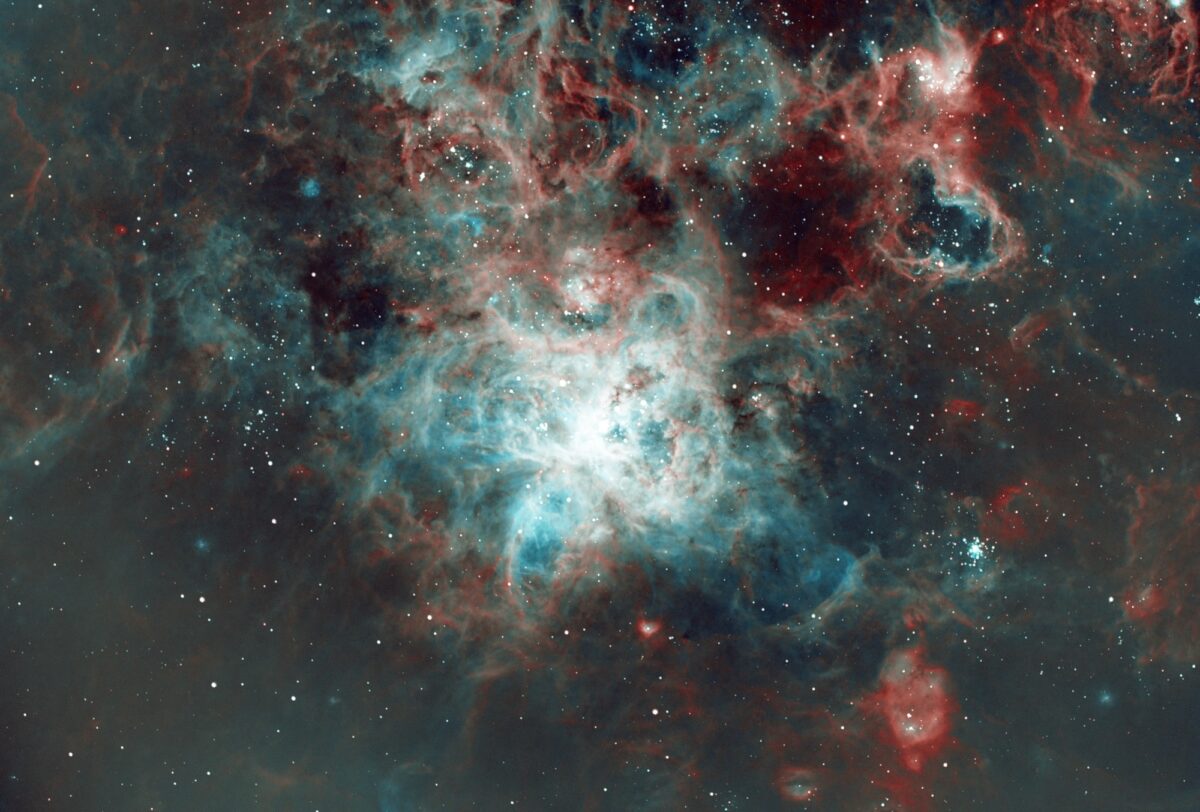
The Tarantula Nebula – also called 30 Doradus or NGC 2070 – is located 170,000 light-years away in the Large Magellanic Cloud, a satellite galaxy of the Milky Way system, and is the most vigorous star-forming region and the largest stellar nursery we know of in the local universe. In fact, if this enormous complex of stars, gas and dust were at the distance of the Orion Nebula, it would be visible during the day and cover a quarter of the sky. Photo: MPAS member Guido Tack
Highlights this month
- 4WedThe Moon passes Mars — 3° apart. (2:45am)
- 4WedQuadrantids meteor shower peaks (up to 110/hr). A bright 93% Moon interferes badly this year.
- 7SatMercury in inferior conjunction with the Sun — lost in the glare. (11:53pm)
- 13FriMars is stationary — resumes direct (eastward) motion. (6:40am)
- 18WedMercury is stationary — resumes direct (eastward) motion. (10:51pm)
- 23MonUranus is stationary — resumes direct (eastward) motion. (12:09pm)
- 26ThuThe Moon passes Jupiter — 4° apart. (9:10pm)
- 30MonMercury at greatest morning elongation (25° from the Sun, mag −0.1) — best morning apparition. (4:40pm)
- 31TueThe Moon passes Mars — 3° apart. (9:07pm)
When observing the skies this month, the Large Magellanic Cloud (LMC) in the constellation Dorado can be seen with binoculars in the evenings. Among its sparkling stars you will find the Tarantula Nebula (NGC 2070), which appears to the naked eye as a glowing patch the size of the full moon.
You will also find the second brightest star, Canopus, in the constellation Carina sitting high in the sky, while Sirius, the brightest star of the entire night sky, is almost overhead. Orion dominates the view with its brightest stars, supergiants blue-white Rigel and red Betelgeuse, also high up, and the Orion Nebula (M42) placed high within the constellation. The prominent upside-down ‘V’ shape of the Hyades open star cluster in Taurus is a fine sight to the naked eye or through binoculars, with nearby Aldebaran, the brightest star in the constellation, shining with a red-orange tint lower in the north.
NGC 2516, the Southern Beehive, is an open cluster in Carina and is well placed this month. To find this spectacular cluster, look just to the left of Epsilon Carinae, officially named Avior, which is the southwestern star in the asterism known as the False Cross. Because NGC 2516 glows at magnitude 3.8, you’ll have no trouble finding it with the naked eye – it’s one of the sky’s 20 brightest open clusters.
Conjunctions with the moon and planets this month, which is when two astronomical objects appear close to each other in the sky, include January 4 with Mars, January 26 with Jupiter and January 31 with Mars again.
Throughout January, the Mornington Peninsula Astronomical Society will be holding its Summer Series public stargazing nights on Friday 6, Saturday 7, Friday 13 and Friday 27 at the MPAS Observatory at The Briars in Mount Martha. Each starts at 8pm with a multimedia talk and Q&A before moving outside to view the moon, planets, stars and clusters, all through a wide array of telescopes supplied by the society and members. Tickets are limited and bookings are necessary, so don’t miss out (MPAS members do not need to book).
By Nerida Langcake
This article appeared in the January 2023 issue of the Mornington Peninsula Magazine.
The sky in detail — January 2023
Sun & twilight
| Date | Sunrise | Sunset | Day length | Astro. dark begins | ends |
|---|---|---|---|---|---|
| Sun 1 | 6:00am | 8:46pm | 14h 47m | 10:42pm | 4:04am |
| Tue 10 | 6:08am | 8:46pm | 14h 39m | 10:39pm | 4:15am |
| Fri 20 | 6:18am | 8:43pm | 14h 25m | 10:31pm | 4:29am |
| Tue 31 | 6:31am | 8:35pm | 14h 04m | 10:18pm | 4:47am |
Days shorten by about 42 minutes over the month.
The Moon
- Full MoonSat 7, 10:13am
- Last QuarterSun 15, 1:15pm
- New MoonSun 22, 7:55am
- First QuarterSun 29, 2:21am
Apogee 8 Jan (406,200 km) · Perigee 22 Jan (356,700 km)
The planets
Rise/set for mid-month at The Briars.
| Planet | In | Mag | Rise | Transit | Set | Best |
|---|---|---|---|---|---|---|
| Mercury | Sgr | 1.2 | 5:14am | 12:21pm | 7:29pm | Hidden |
| Venus | Cap | −3.7 | 7:52am | 2:55pm | 9:56pm | Hidden |
| Mars | Tau | −0.8 | 5:26pm | 10:05pm | 2:47am | Evening |
| Jupiter | Psc | −2.0 | 11:54am | 5:56pm | 12:01am | Evening |
| Saturn | Cap | 0.7 | 8:39am | 3:29pm | 10:19pm | Hidden |
| Uranus | Ari | 5.7 | 3:22pm | 8:32pm | 1:46am | Evening |
| Neptune | Psc | 7.9 | 11:05am | 5:19pm | 11:33pm | Evening |
Meteor showers
- Quadrantids — peaks 4 January, radiant in Boötes (up to 110/hr). Radiant stays below the horizon from Victoria — essentially a no-show this far south. A bright 93% Moon interferes badly this year.
Computed for The Briars, Mt Martha. Times are local (Melbourne).
Generated automatically from the MPAS sky engine on 24 October 2026.
The solar system — January 2023
Evening sky Morning sky Up much of the night Lost in the Sun’s glare
Open the full interactive orrery ↗ — fast-forward, pick any date, toggle the Moon and more.
Looking for an earlier month? Browse all past monthly guides →