
Highlights this month
- 17FriSaturn in superior conjunction with the Sun — lost in the glare. (3:29am)
- 28TueThe Moon passes Mars — 1° apart. (3:16pm)

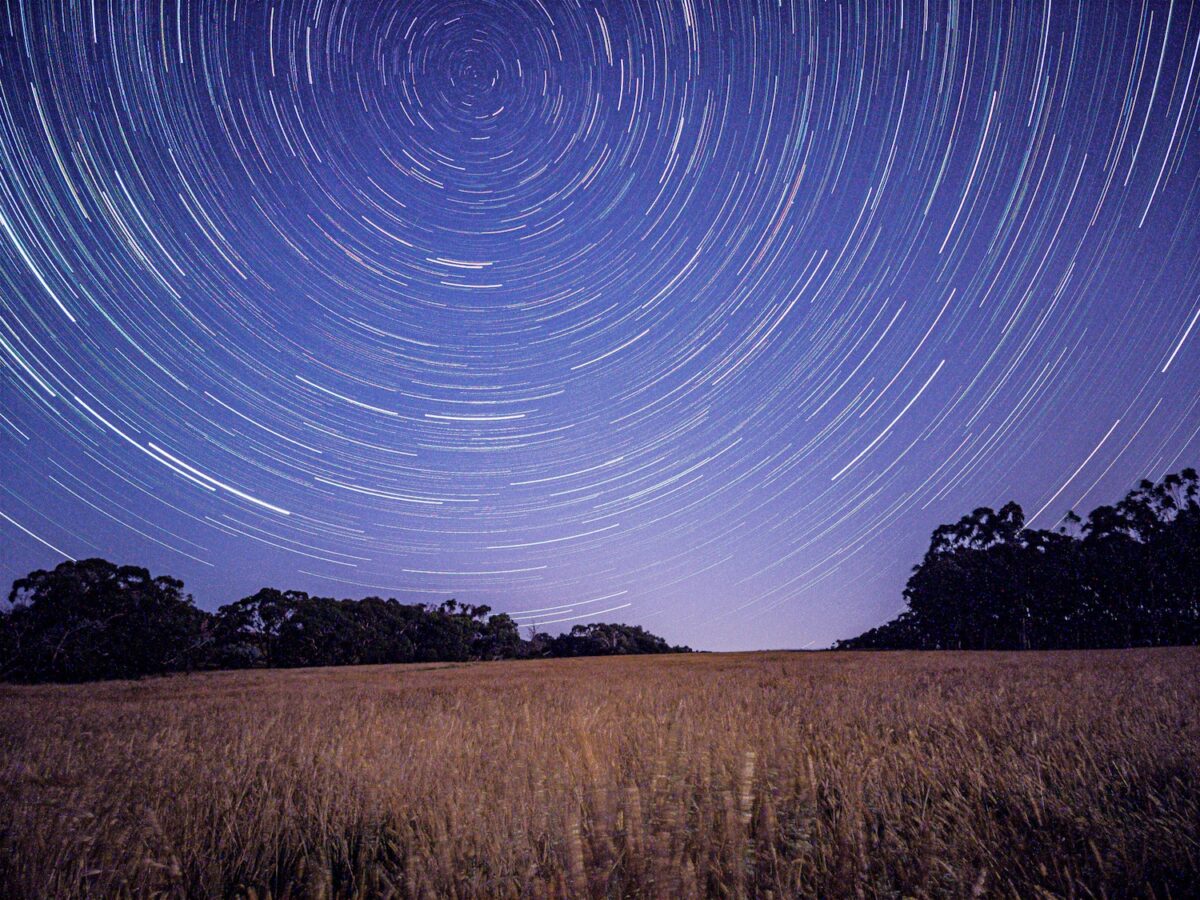
You don’t need expensive equipment to get great shots of the night sky. These gorgeous images of the aurora australis and star trails were both taken at The Briars in Mount Martha using a smartphone. Photos: MPAS member Nerida Langcake
Now is a good time to observe and admire the rich star fields of the Milky Way stretching across the southern skies. To scan these stars, you only need your eyes or a pair of binoculars. Look out for the Milky Way running through the constellations Crux, Centaurus, Musca and Carina in the east. Be sure to observe the Coalsack Nebula, a distinctive dark patch close to the stars of Crux, the Southern Cross. This dark nebula is a cloud of dust and gas about 600 light-years away. Also look for an open cluster in the constellation Carina known to astronomers as the Southern Pleiades (IC2602). It is visible to the naked eye, but binoculars show it twinkling away.
The two brightest stars in the sky this month are Sirius and Canopus. And two stunning constellations – Crux, the Southern Cross, and Centaurus, the Centaur – are also visible. A little way above them you will find the deceptive False Cross, sometimes mistaken for the true Southern Cross. The False Cross is formed by four stars in Vela and Carina.
The constellation Puppis, the Stern, sits in the night sky just north of the bright star Canopus and is wedged between the constellations Vela, Carina and Canis Major. Puppis is home to the open star clusters M46 and M47, which can be seen with a pair of binoculars.
Don’t know how to use your new – or old – telescope, or interested in purchasing one but don’t know where to start? February 25 is Telescope Learning Day at the Mornington Peninsula Astronomical Society and is a much anticipated event for 2023. Come and learn from scratch about how telescopes work, how best to use them and what to point them at. Get heaps of practical hints, tips and tricks from seasoned expert sky observers. There’ll even be a barbecue. Bookings are essential if you are not an MPAS member.
By Nerida Langcake
This article appeared in the February 2023 issue of the Mornington Peninsula Magazine.
The sky in detail — February 2023
Sun & twilight
| Date | Sunrise | Sunset | Day length | Astro. dark begins | ends |
|---|---|---|---|---|---|
| Wed 1 | 6:32am | 8:34pm | 14h 02m | 10:17pm | 4:49am |
| Fri 10 | 6:42am | 8:25pm | 13h 43m | 10:04pm | 5:03am |
| Mon 20 | 6:53am | 8:13pm | 13h 20m | 9:48pm | 5:18am |
| Tue 28 | 7:02am | 8:02pm | 13h 00m | 9:34pm | 5:29am |
Days shorten by about 62 minutes over the month.
The Moon
- Full MoonMon 6, 5:31am
- Last QuarterTue 14, 3:08am
- New MoonMon 20, 6:06pm
- First QuarterMon 27, 7:11pm
Apogee 4 Feb (406,200 km) · Perigee 19 Feb (358,200 km)
The planets
Rise/set for mid-month at The Briars.
| Planet | In | Mag | Rise | Transit | Set | Best |
|---|---|---|---|---|---|---|
| Mercury | Cap | −0.2 | 5:00am | 12:11pm | 7:22pm | Hidden |
| Venus | Psc | −3.7 | 9:04am | 3:19pm | 9:33pm | Hidden |
| Mars | Tau | 0.1 | 3:53pm | 8:29pm | 1:08am | Evening |
| Jupiter | Psc | −1.9 | 10:20am | 4:14pm | 10:09pm | Hidden |
| Saturn | Cap | 0.7 | 6:55am | 1:41pm | 8:27pm | Hidden |
| Uranus | Ari | 5.8 | 1:21pm | 6:31pm | 11:41pm | Evening |
| Neptune | Psc | 7.9 | 9:07am | 3:20pm | 9:33pm | Hidden |
Computed for The Briars, Mt Martha. Times are local (Melbourne).
Generated automatically from the MPAS sky engine on 14 August 2026.
The solar system — February 2023
Evening sky Morning sky Up much of the night Lost in the Sun’s glare
Open the full interactive orrery ↗ — fast-forward, pick any date, toggle the Moon and more.
Looking for an earlier month? Browse all past monthly guides →