
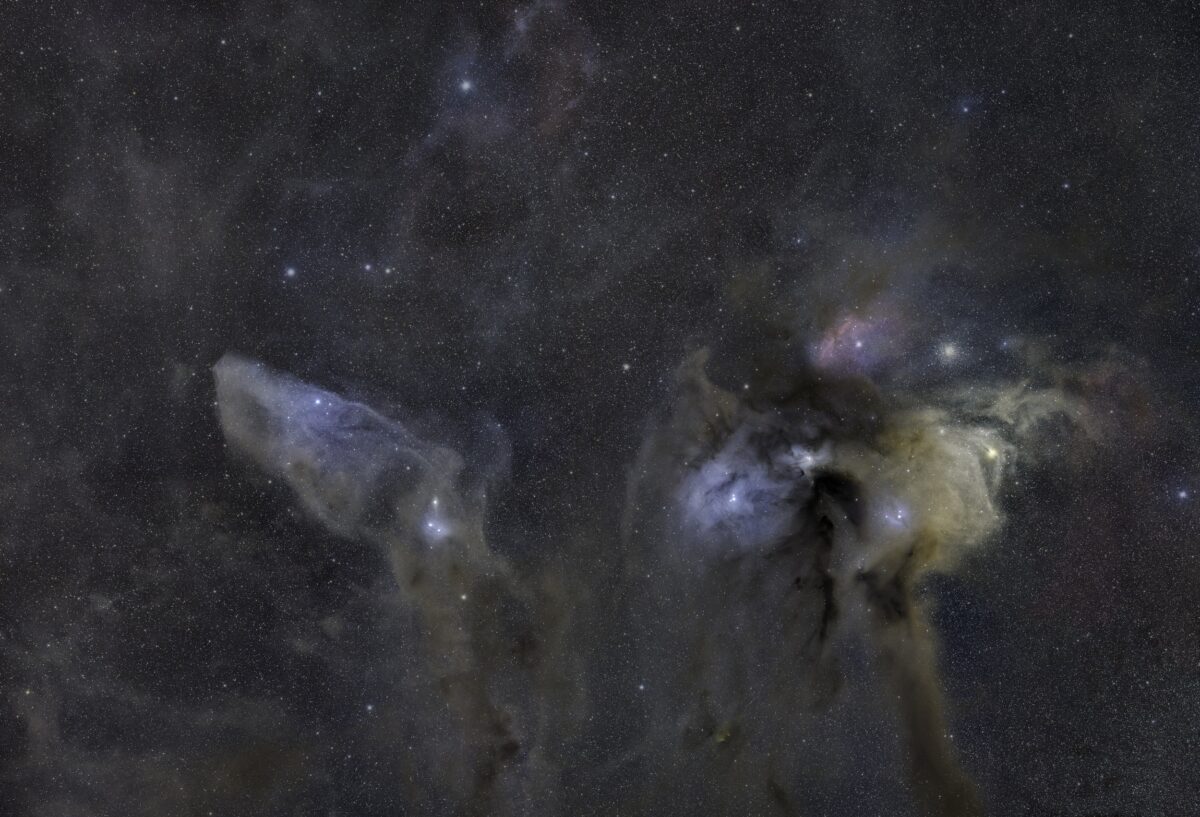
The Rho Ophiuchi cloud complex and the Blue Horsehead Nebula – also known as IC 4592 – are both about 420 light-years away in the constellations Ophiuchus and Scorpius. Photo: MPAS member Hugh Coleman
Highlights this month
- 1MonSaturn is stationary — begins retrograde (westward) motion. (5:40am)
- 2TueThe Moon passes Mars — 5° apart. (4:19am)
- 3WedNeptune is stationary — begins retrograde (westward) motion. (6:21am)
- 22MonMercury at greatest evening elongation (27° from the Sun, mag 0.4) — best evening apparition. (4:33pm)
- 25ThuThe Moon passes Saturn — 1° apart. (6:34am)
- 30TueSouthern Delta Aquariids meteor shower peaks (up to 25/hr). A 27% Moon washes out fainter meteors for part of the night.
- 30TueAlpha Capricornids meteor shower peaks (up to 5/hr). A 27% Moon washes out fainter meteors for part of the night.
In July, if you look towards the constellations Sagittarius and Scorpius on a clear night, you are looking in the direction of the very heart of our galaxy. Sagittarius, the Archer, is nestled within a mesmerisingly detailed part of the Milky Way. You can find it by first locating the Teapot asterism, which forms the constellation’s hub, close to a notably bright swathe of the Milky Way. A scan of Sagittarius with binoculars or a small telescope will reveal many rich star clusters and bright nebulae.
Scorpius is easy to find, sitting high in the sky and being one of the brightest constellations. Nearby is the slightly less prominent constellation Libra. This whole region is full of rich and beautiful star fields, which are a joy to explore using binoculars. If you turn to the constellation Libra, the Scales, look out for the second brightest star, which is called Zubenelgenubi – Arabic for “the Southern Claw” – and is the brighter component of the Alpha Librae system. It is a binary star system with the two stars in orbit around each other, and a pair of binoculars easily shows its two stars.
At this time of the year, Sagittarius offers some exceptional deep-sky objects. The globular cluster M22 is visible to the naked eye if you have good observing conditions. The Lagoon Nebula, or M8, lying above the spout of the Teapot, is a glowing cloud of gas. Other famous deep-sky objects in Sagittarius are visible through a telescope, including the Trifid Nebula, or M20. Beside Sagittarius, Scorpius contains the bright open clusters M6 and M7, which remain high in the sky this month. To the north in the constellation Serpens Cauda, the Tail of the Serpent, lies the open cluster M16 in the much fainter Eagle Nebula.
This month’s conjunctions, which is when two astronomical objects appear close to each other in the sky, include the moon and Jupiter on July 3, the moon and Saturn on July 25, the moon and Mars on July 30, and the moon and Jupiter again on July 31. Also, two meteor showers – the Alpha Capricornids and the Southern Delta Aquariids – will peak on July 29.
By Nerida Langcake
This article appeared in the July 2024 issue of the Mornington Peninsula Magazine.
The sky in detail — July 2024
Sun & twilight
| Date | Sunrise | Sunset | Day length | Astro. dark begins | ends |
|---|---|---|---|---|---|
| Mon 1 | 7:37am | 5:10pm | 9h 33m | 6:45pm | 6:03am |
| Wed 10 | 7:35am | 5:15pm | 9h 40m | 6:49pm | 6:02am |
| Sat 20 | 7:31am | 5:22pm | 9h 52m | 6:55pm | 5:58am |
| Wed 31 | 7:22am | 5:31pm | 10h 09m | 7:02pm | 5:51am |
Days lengthen by about 36 minutes over the month.
The Moon
- New MoonSat 6, 8:54am
- First QuarterSun 14, 8:49am
- Full MoonSun 21, 8:26pm
- Last QuarterSun 28, 12:52pm
Apogee 12 Jul (404,900 km) · Perigee 24 Jul (364,900 km)
The planets
Rise/set for mid-month at The Briars.
| Planet | In | Mag | Rise | Transit | Set | Best |
|---|---|---|---|---|---|---|
| Mercury | Leo | 0.1 | 8:59am | 2:12pm | 7:25pm | Evening |
| Venus | Cnc | −3.7 | 8:19am | 1:14pm | 6:09pm | Hidden |
| Mars | Tau | 1.0 | 3:20am | 8:22am | 1:24pm | Morning |
| Jupiter | Tau | −1.8 | 4:35am | 9:25am | 2:16pm | Morning |
| Saturn | Aqr | 0.9 | 9:46pm | 4:11am | 10:32am | Morning |
| Uranus | Tau | 5.8 | 3:24am | 8:23am | 1:22pm | Morning |
| Neptune | Psc | 7.8 | 10:39pm | 4:49am | 10:55am | Morning |
Meteor showers
- Southern Delta Aquariids — peaks 30 July, radiant in Aquarius (up to 25/hr). A favourite southern shower with a high radiant — steady rates through the small hours; overlaps the Alpha Capricornids. A 27% Moon washes out fainter meteors for part of the night.
- Alpha Capricornids — peaks 30 July, radiant in Capricornus (up to 5/hr). Low rates but noted for slow, bright fireballs; radiant well placed from the south. A 27% Moon washes out fainter meteors for part of the night.
Computed for The Briars, Mt Martha. Times are local (Melbourne).
Generated automatically from the MPAS sky engine on 24 October 2026.
The solar system — July 2024
Evening sky Morning sky Up much of the night Lost in the Sun’s glare
Open the full interactive orrery ↗ — fast-forward, pick any date, toggle the Moon and more.
Looking for an earlier month? Browse all past monthly guides →