
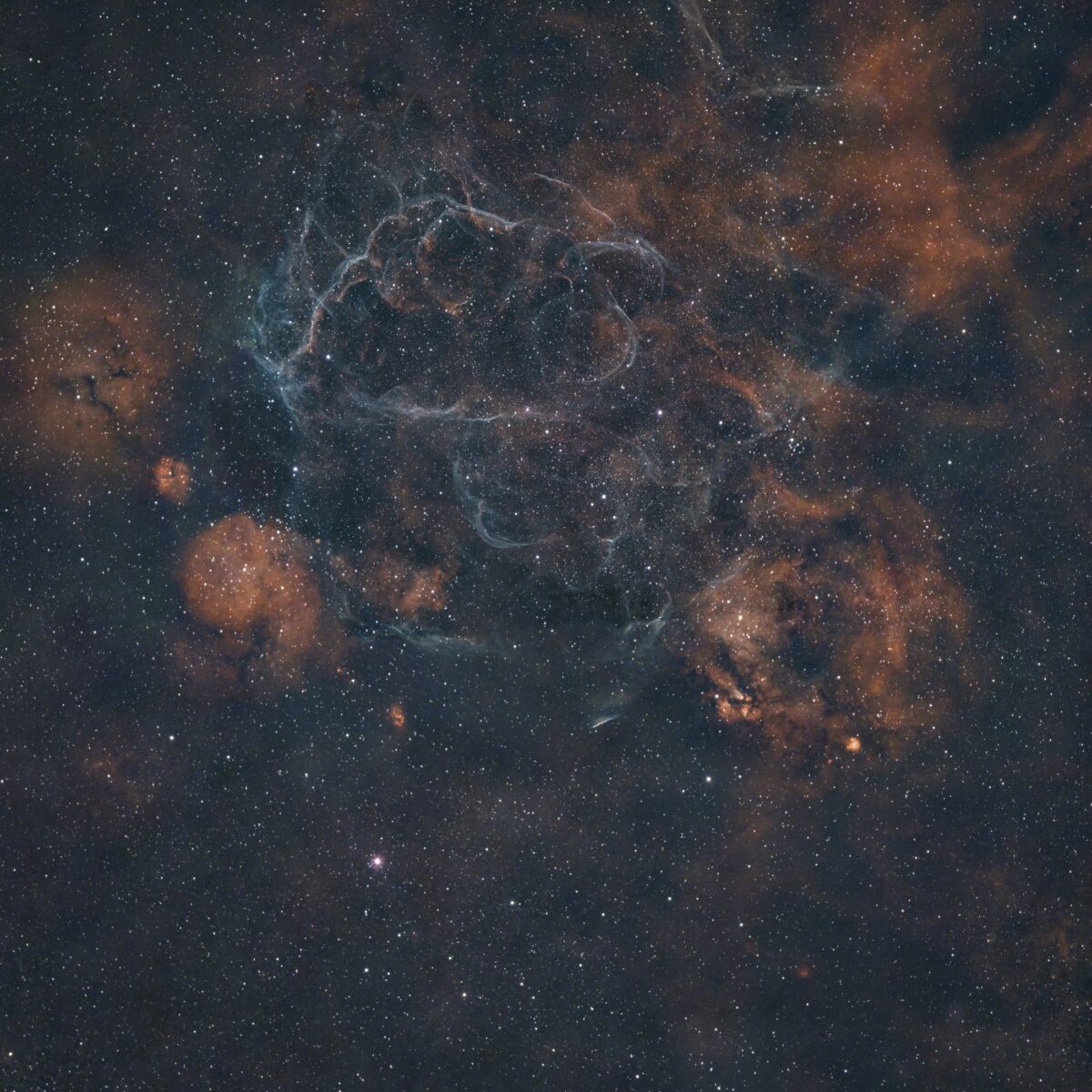
The Vela Supernova Remnant is a massive object mostly made up of hydrogen alpha and oxygen III in the constellation Vela. It was created from the supernova explosion of a massive star some 11,000 to 12,300 years ago. The Vela Supernova Remnant was born from a Type II supernova and is one of the closest supernova remnants to Earth. Photo: MPAS member Kelly Clitheroe
Highlights this month
- 5WedJupiter is stationary — resumes direct (eastward) motion. (12:16am)
- 9SunMercury in superior conjunction with the Sun — lost in the glare. (10:54pm)
- 10MonThe Moon passes Mars — 3° apart. (2:54am)
- 24MonMars is stationary — resumes direct (eastward) motion. (7:44pm)
- 28FriVenus is stationary — begins retrograde (westward) motion. (2:06pm)
Looking north, in the constellation Cancer, the Crab, look out for the wonderful star cluster M44, also known as the Beehive Cluster or Praesepe. Easy to locate, it sits at the very centre of the constellation, close to the stars Gamma (γ) and Delta (δ) Cancri. M44 appears as a misty patch to the naked eye from a dark sky location, and as a glittering collection of stars though binoculars. Also on show, and best seen with a telescope, are the interesting spiral galaxies M65 and M66 in Leo, the Lion. These galaxies appear as elliptical smudges though a telescope.
This is a good time to observe and admire the rich star fields of the Milky Way stretching across the southern skies. To scan these stars, you only need your eyes or a pair of binoculars. Look out for the Milky Way running through the constellations Crux, Centaurus, Musca and Carina in the east. Be sure to observe the Coalsack Nebula, a distinctive dark patch close to the stars of Crux, the Southern Cross. This dark nebula is a cloud of dust and gas about 600 light-years away. Also look for an open cluster in the constellation Carina known to astronomers as the Southern Pleiades (IC2602). It is visible to the naked eye, but binoculars show it twinkling away.
Conjunctions are when two astronomical objects appear close to each other in the sky, and there are lots this month, including February 1 with the moon and Saturn, February 2 with the moon and Venus, February 4 with Venus and Neptune, February 7 with the moon and Jupiter, February 10 with the moon and Mars, and February 26 with Mercury and Saturn.
The Mornington Peninsula Astronomical Society will again be holding its Musical Trivia Stargazing night on Saturday, February 15, at the Mount Martha Observatory at The Briars. It includes live music from the Cranbourne Lions Concert Band, a fundraising sausage sizzle, trivia quiz, and of course stargazing through the telescopes. Kids under 16 are admitted free. Visit our website to book now.
By Nerida Langcake
This article appeared in the February 2025 issue of the Mornington Peninsula Magazine.
The sky in detail — February 2025
Sun & twilight
| Date | Sunrise | Sunset | Day length | Astro. dark begins | ends |
|---|---|---|---|---|---|
| Sat 1 | 6:32am | 8:34pm | 14h 01m | 10:16pm | 4:50am |
| Mon 10 | 6:43am | 8:25pm | 13h 42m | 10:03pm | 5:04am |
| Thu 20 | 6:54am | 8:12pm | 13h 18m | 9:47pm | 5:19am |
| Fri 28 | 7:03am | 8:01pm | 12h 59m | 9:34pm | 5:30am |
Days shorten by about 62 minutes over the month.
The Moon
- First QuarterWed 5, 7:01pm
- Full MoonThu 13, 12:55am
- Last QuarterFri 21, 4:37am
- New MoonFri 28, 11:47am
Perigee 2 Feb (367,400 km) · Apogee 18 Feb (405,200 km)
The planets
Rise/set for mid-month at The Briars.
| Planet | In | Mag | Rise | Transit | Set | Best |
|---|---|---|---|---|---|---|
| Mercury | Aqr | −1.5 | 7:08am | 1:53pm | 8:38pm | Hidden |
| Venus | Psc | −4.7 | 10:15am | 3:56pm | 9:37pm | Hidden |
| Mars | Gem | −0.7 | 6:24pm | 10:55pm | 3:31am | Evening |
| Jupiter | Tau | −2.2 | 3:28pm | 8:17pm | 1:10am | Evening |
| Saturn | Aqr | 1.0 | 8:39am | 3:01pm | 9:22pm | Hidden |
| Uranus | Ari | 5.8 | 2:00pm | 7:02pm | 12:07am | Evening |
| Neptune | Psc | 7.9 | 9:27am | 3:34pm | 9:42pm | Hidden |
Computed for The Briars, Mt Martha. Times are local (Melbourne).
Generated automatically from the MPAS sky engine on 24 October 2026.
The solar system — February 2025
Evening sky Morning sky Up much of the night Lost in the Sun’s glare
Open the full interactive orrery ↗ — fast-forward, pick any date, toggle the Moon and more.
Looking for an earlier month? Browse all past monthly guides →