
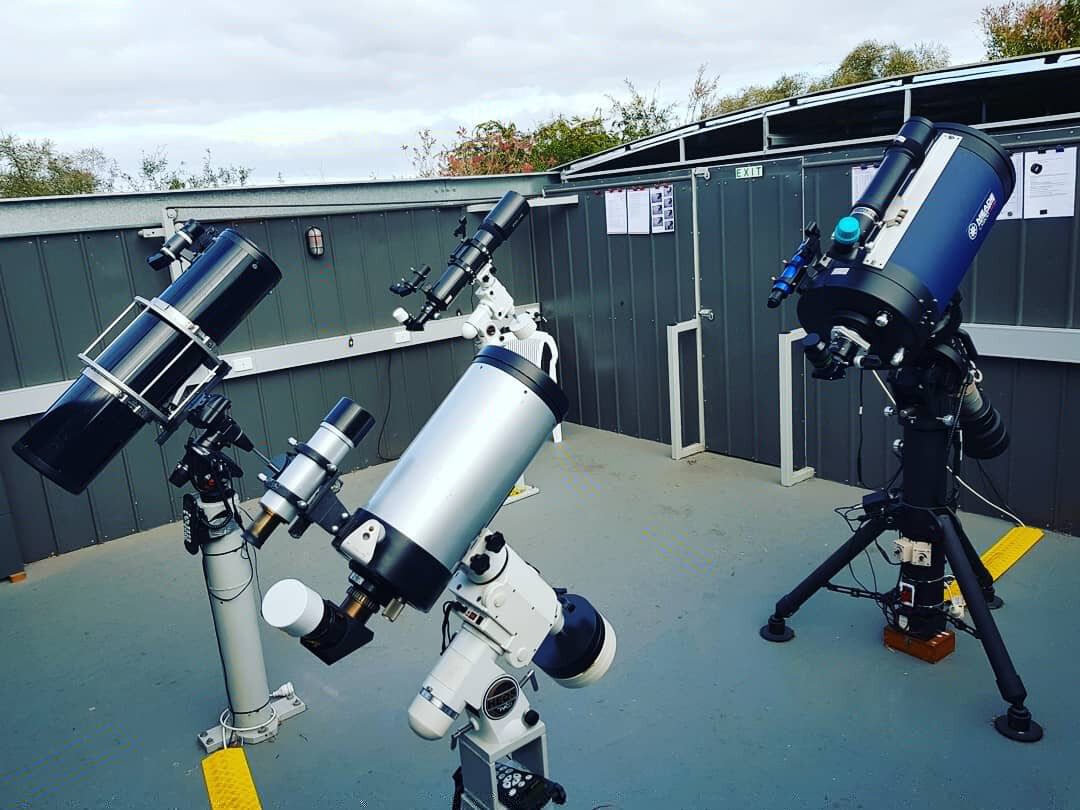
The Mornington Peninsula Astronomical Society has plenty of telescopes through which the public can view the night sky each month. Photo: Nerida Langcake
Highlights this month
- 11TueMercury at greatest evening elongation (18° from the Sun, mag −0.6) — best evening apparition. (12:48am)
- 16SunMercury is stationary — begins retrograde (westward) motion. (9:11pm)
- 19WedThe Moon passes Mars — 2° apart. (2:56am)
- 20ThuThe Moon passes Jupiter — 0.5° apart. (5:14am)
- 21FriThe Moon passes Saturn — 3° apart. (4:48am)
- 26WedMercury in inferior conjunction with the Sun — lost in the glare. (12:39pm)
Observing the southern skies this month you will find two stellar beacons shining away high in the sky. These are the two brightest stars in the night sky — Sirius and Canopus.
The waxing moon will be seen close to Mars in the morning of February 19, extremely close to Jupiter in the morning of February 20, and close to Saturn in the morning of February 21. On February 27 the waning crescent moon will appear close to Venus. Then on February 29 Mars will be close to globular cluster M22, which is an elliptical globular cluster of stars in the constellation Sagittarius, near the galactic bulge region, and is one of the brightest globulars that is visible in the night sky.
This is a good time to observe and admire the rich star fields of the Milky Way stretching across the southern skies. To scan these stars, you only need your eyes or a pair of binoculars. Look out for the Milky Way running through the constellations Crux, Centaurus, Musca and Carina in the east. Be sure to observe the Coalsack Nebula, a distinctive dark patch close to the stars of Crux, the Southern Cross. This dark nebula is a cloud of dust and gas about 600 light-years away. Also look for an open cluster in the constellation Carina known to astronomers as the Southern Pleiades (IC2602). It is visible to the naked eye, but binoculars show it twinkling away.
The Mornington Peninsula Astronomical Society will be holding its monthly public stargazing night on Friday, February 7, at the MPAS Observatory at The Briars in Mount Martha. It starts at 8pm with a multimedia talk and Q&A before moving outside to view the moon, planets, stars and clusters, all through a wide array of telescopes supplied by the society and members. These nights are great fun for the whole family.
Then on February 19, Professor Ilya Mandel, from Monash University and chief investigator of the ARC Centre for Excellence in Gravitational Wave Discovery (OzGrav), will be speaking on gravitational wave astronomy, with the general public welcome to attend.
By Nerida Langcake
This article appeared in the February 2020 issue of the Mornington Peninsula Magazine.
The sky in detail — February 2020
Sun & twilight
| Date | Sunrise | Sunset | Day length | Astro. dark begins | ends |
|---|---|---|---|---|---|
| Sat 1 | 6:32am | 8:34pm | 14h 03m | 10:17pm | 4:48am |
| Mon 10 | 6:42am | 8:25pm | 13h 43m | 10:04pm | 5:03am |
| Thu 20 | 6:53am | 8:13pm | 13h 20m | 9:48pm | 5:18am |
| Sat 29 | 7:03am | 8:01pm | 12h 58m | 9:33pm | 5:30am |
Days shorten by about 65 minutes over the month.
The Moon
- First QuarterSun 2, 12:43pm
- Full MoonSun 9, 6:34pm
- Last QuarterSun 16, 9:18am
- New MoonMon 24, 2:36am
Perigee 11 Feb (360,800 km) · Apogee 26 Feb (406,000 km)
The planets
Rise/set for mid-month at The Briars.
| Planet | In | Mag | Rise | Transit | Set | Best |
|---|---|---|---|---|---|---|
| Mercury | Aqr | 0.2 | 8:16am | 2:34pm | 8:52pm | Hidden |
| Venus | Psc | −4.0 | 10:20am | 4:12pm | 10:04pm | Hidden |
| Mars | Sgr | 1.3 | 2:14am | 9:38am | 5:01pm | Morning |
| Jupiter | Sgr | −1.7 | 3:36am | 10:54am | 6:12pm | Morning |
| Saturn | Sgr | 0.5 | 4:24am | 11:36am | 6:48pm | Morning |
| Uranus | Ari | 5.9 | 12:22pm | 5:45pm | 11:08pm | Evening |
| Neptune | Aqr | 7.9 | 8:37am | 2:57pm | 9:18pm | Hidden |
Computed for The Briars, Mt Martha. Times are local (Melbourne).
Generated automatically from the MPAS sky engine on 24 October 2026.
The solar system — February 2020
Evening sky Morning sky Up much of the night Lost in the Sun’s glare
Open the full interactive orrery ↗ — fast-forward, pick any date, toggle the Moon and more.
Looking for an earlier month? Browse all past monthly guides →