
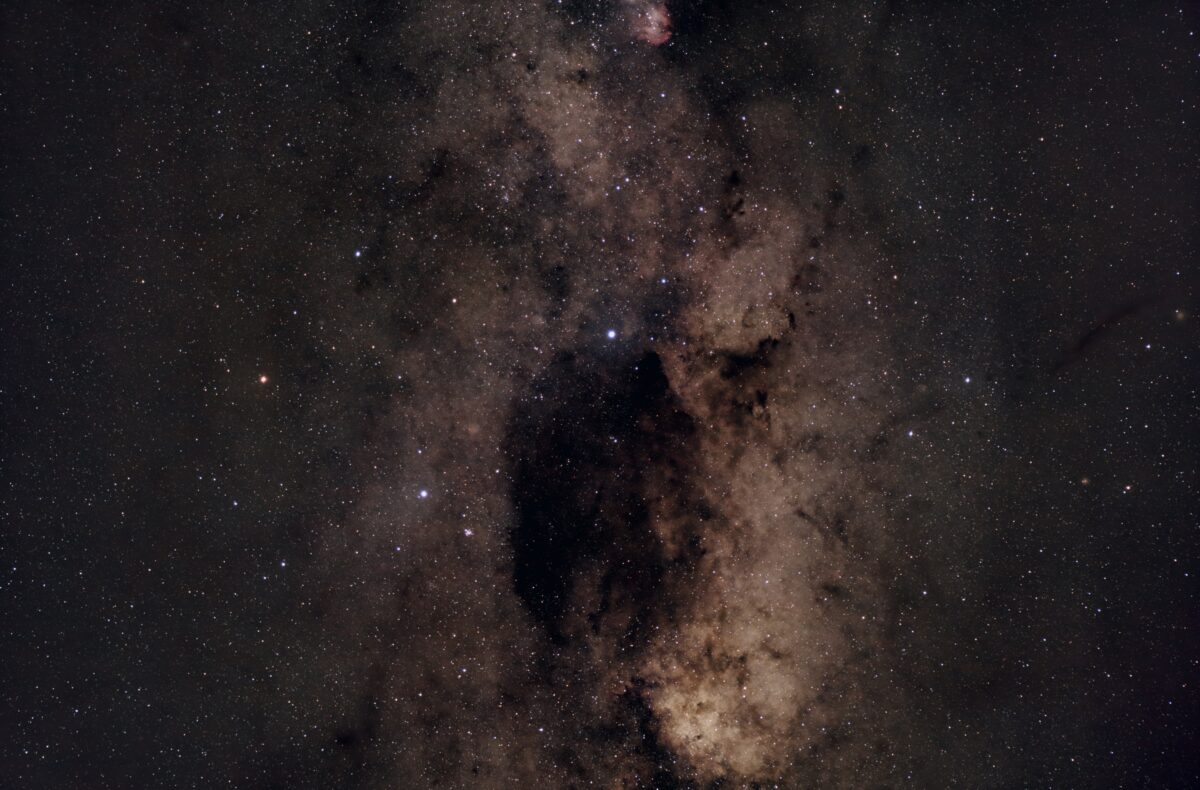
The Coalsack is a dark nebula visible to the unaided eye as a black patch obscuring part of the Milky Way about 600 light-years away in Crux, the Southern Cross. Photo: MPAS member Chris Kostokanellis
Highlights this month
- 4SatMercury at greatest morning elongation (28° from the Sun, mag 0.3) — best morning apparition. (9:31am)
- 20MonMars and Saturn in conjunction — 1° apart. (6:22am)
- 21TueMercury and Saturn in conjunction — 0.7° apart. (5:32am)
- 21TueMercury and Mars in conjunction — 2° apart. (6:20am)
- 23ThuLyrids meteor shower peaks (up to 18/hr). A 41% Moon washes out fainter meteors for part of the night.
By far the most impressive sight this month is the great arc of the Milky Way. It stretches all the way from the magnificent region in the east around the constellations Scorpius and Sagittarius, through Crux, Carina and Vela, down to Puppis and Canis Major. The bright star Acrux, or Alpha Crucis, is a multiple star in Crux that can be resolved by a small telescope. M83, or the Southern Pinwheel, is an excellent large-aperture telescope object in Hydra.
The very finest of all globular clusters is the startlingly bright Omega Centauri (NGC 5139). This 13 billion-year-old, one million star-strong globular, thought to be the nucleus of a dwarf galaxy that collided with the Milky Way, can be found by making an equilateral triangle using The Pointers, Crux, and Epsilon Centauri.
Leo hosts many interesting galaxies that can been seen with relatively modest amateur equipment. These include the Leo Triplet (the M66 Group), made up of the bright spiral galaxies M65, M66 and NGC 3268; and the Leo I Group (M96 Group), between eight and 24 galaxies that include three bright Messier galaxies: the spirals M95 and M96, and the elliptical galaxy M105. They are found clustered round a region roughly halfway between the stars Chertan (Theta Leonis) and Regulus (Alpha Leonis). M65 and M66 appear as grey smudges through a small telescope.
The Lyrid meteor shower will peak around April 22-23, with up to 18 meteors visible an hour. Named after constellation Lyra, it’s one of the oldest recorded meteor showers; according to some historical Chinese texts, it was seen more than 2500 years ago. The meteors are created by debris from comet Thatcher, which takes about 415 years to orbit the sun.
This month’s conjunctions, which is when two astronomical objects appear close to each other, include Mars with Neptune on April 13; the moon with Mercury, the moon with Mars and the moon with Saturn on April 16; Mercury with Neptune on April 17; the moon with Venus on April 19; Mercury with Mars then Mercury with Saturn on April 20; Saturn with Mars on April 21; the moon with Jupiter on April 23; and Venus with Uranus on April 24.
By Nerida Langcake
This article appeared in the April 2026 issue of the Mornington Peninsula Magazine.
The sky in detail — April 2026
Sun & twilight
| Date | Sunrise | Sunset | Day length | Astro. dark begins | ends |
|---|---|---|---|---|---|
| Wed 1 | 7:34am | 7:13pm | 11h 40m | 8:41pm | 6:06am |
| Fri 10 | 6:42am | 6:00pm | 11h 18m | 7:28pm | 5:14am |
| Mon 20 | 6:51am | 5:46pm | 10h 55m | 7:14pm | 5:23am |
| Thu 30 | 7:00am | 5:33pm | 10h 33m | 7:03pm | 5:31am |
Days shorten by about 67 minutes over the month.
The Moon
- Full MoonThu 2, 1:15pm
- Last QuarterFri 10, 2:50pm
- New MoonFri 17, 9:55pm
- First QuarterFri 24, 12:34pm
Apogee 7 Apr (405,300 km) · Perigee 19 Apr (361,800 km)
The planets
Rise/set for mid-month at The Briars.
| Planet | In | Mag | Rise | Transit | Set | Best |
|---|---|---|---|---|---|---|
| Mercury | Psc | −0.0 | 4:39am | 10:50am | 5:01pm | Morning |
| Venus | Ari | −3.7 | 8:47am | 1:52pm | 6:58pm | Hidden |
| Mars | Psc | 1.2 | 5:03am | 11:03am | 5:04pm | Hidden |
| Jupiter | Gem | −1.9 | 1:14pm | 6:00pm | 10:45pm | Evening |
| Saturn | Psc | 0.8 | 5:18am | 11:17am | 5:16pm | Hidden |
| Uranus | Tau | 5.8 | 9:39am | 2:36pm | 7:32pm | Hidden |
| Neptune | Psc | 7.9 | 4:57am | 10:59am | 5:01pm | Morning |
Meteor showers
- Lyrids — peaks 23 April, radiant in Lyra (up to 18/hr). A modest shower; the radiant is low in the north-east before dawn from Victoria. A 41% Moon washes out fainter meteors for part of the night.
Computed for The Briars, Mt Martha. Times are local (Melbourne).
Generated automatically from the MPAS sky engine on 20 September 2026.
The solar system — April 2026
Evening sky Morning sky Up much of the night Lost in the Sun’s glare
Open the full interactive orrery ↗ — fast-forward, pick any date, toggle the Moon and more.
Looking for an earlier month? Browse all past monthly guides →