
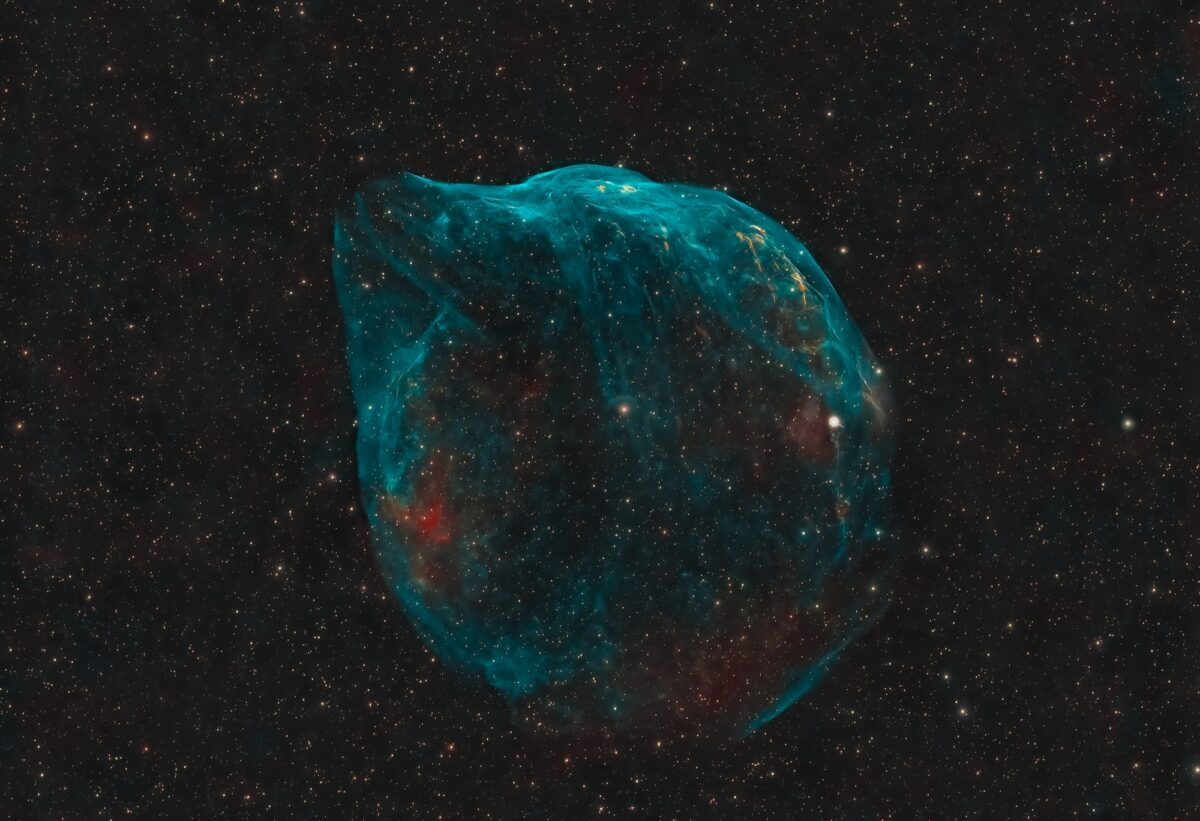
Blown by fast wind from a hot, massive star, this cosmic bubble called the Dolphin Nebula is much larger than the dolphin it appears to be. It lies some 5200 light-years away towards the constellation of Canis Major and covers slightly more of the sky than a full moon. That corresponds to a diameter of 60 light-years at its estimated distance. Photo: MPAS member Nik Axaris
Highlights this month
- 16ThuNeptune in superior conjunction with the Sun — lost in the glare. (10:37am)
- 17FriMercury in superior conjunction with the Sun — lost in the glare. (9:34pm)
- 20MonThe Moon passes Saturn — 3° apart. (4:41am)
- 21TueAutumn equinox.
- 29WedThe Moon passes Mars — 2° apart. (12:10am)
Observing the stars in March, your eyes will undoubtedly be drawn to the constellations sitting in the southeast, centred around the Southern Cross (Crux) and Centaurus. Just above Crux, a little further in Carina, is a glowing region known as the Eta Carina Nebula (NGC 3372). It is visible to the naked eye against the Milky Way, with a dark lane of dust running through it, and it is beautiful when observed through a small telescope.
This month you can see plenty of objects with a good pair of binoculars, including the open cluster known as the Southern Pleiades (IC 2602). Its brightest member, the star Theta Carinae, can be seen with the naked eye. If you turn binoculars on the cluster, you can see about 24 other sparkling stars.
This month’s conjunctions, which is when two astronomical objects appear close to each other in the sky, include Venus and Jupiter on March 2, the moon and Venus on March 24, and the moon and Mars on March 29. Then on Tuesday, March 21, Earth is at equinox, which is when Earth’s two hemispheres are receiving the sun’s rays equally.
This Saturday, March 4, join the Mornington Peninsula Astronomical Society for Close Encounters of the Fourth Kind: A Musical Stargazing Trivia Soiree. There is a door prize of a pair of Saxon 7×50 wide-angle binoculars, as well as raffles, a trivia competition including music, astronomy and general knowledge questions, sausages and burgers to buy on the night, and of course stargazing throughout the evening. There is also live music from our event partners at the Southern Peninsula Concert Band. Dress in a space-themed outfit for a chance to win spot prizes.
By Nerida Langcake
This article appeared in the March 2023 issue of the Mornington Peninsula Magazine.
The sky in detail — March 2023
Sun & twilight
| Date | Sunrise | Sunset | Day length | Astro. dark begins | ends |
|---|---|---|---|---|---|
| Wed 1 | 7:03am | 8:01pm | 12h 58m | 9:33pm | 5:31am |
| Fri 10 | 7:12am | 7:48pm | 12h 35m | 9:17pm | 5:42am |
| Mon 20 | 7:22am | 7:32pm | 12h 10m | 9:01pm | 5:53am |
| Fri 31 | 7:32am | 7:15pm | 11h 43m | 8:43pm | 6:05am |
Days shorten by about 75 minutes over the month.
The Moon
- Full MoonTue 7, 11:41pm
- Last QuarterWed 15, 1:16pm
- New MoonWed 22, 4:25am
- First QuarterWed 29, 1:37pm
Apogee 4 Mar (405,900 km) · Perigee 19 Mar (362,400 km) · Apogee 31 Mar (405,200 km)
The planets
Rise/set for mid-month at The Briars.
| Planet | In | Mag | Rise | Transit | Set | Best |
|---|---|---|---|---|---|---|
| Mercury | Psc | −1.6 | 7:04am | 1:23pm | 7:41pm | Hidden |
| Venus | Psc | −3.8 | 10:04am | 3:33pm | 9:02pm | Hidden |
| Mars | Tau | 0.7 | 2:54pm | 7:28pm | 12:04am | Evening |
| Jupiter | Psc | −1.9 | 9:01am | 2:47pm | 8:34pm | Hidden |
| Saturn | Aqr | 0.8 | 5:22am | 12:04pm | 6:46pm | Morning |
| Uranus | Ari | 5.8 | 11:35am | 4:44pm | 9:53pm | Evening |
| Neptune | Psc | 7.9 | 7:22am | 1:34pm | 7:45pm | Hidden |
Computed for The Briars, Mt Martha. Times are local (Melbourne).
Generated automatically from the MPAS sky engine on 15 August 2026.
The solar system — March 2023
Evening sky Morning sky Up much of the night Lost in the Sun’s glare
Open the full interactive orrery ↗ — fast-forward, pick any date, toggle the Moon and more.
Looking for an earlier month? Browse all past monthly guides →