
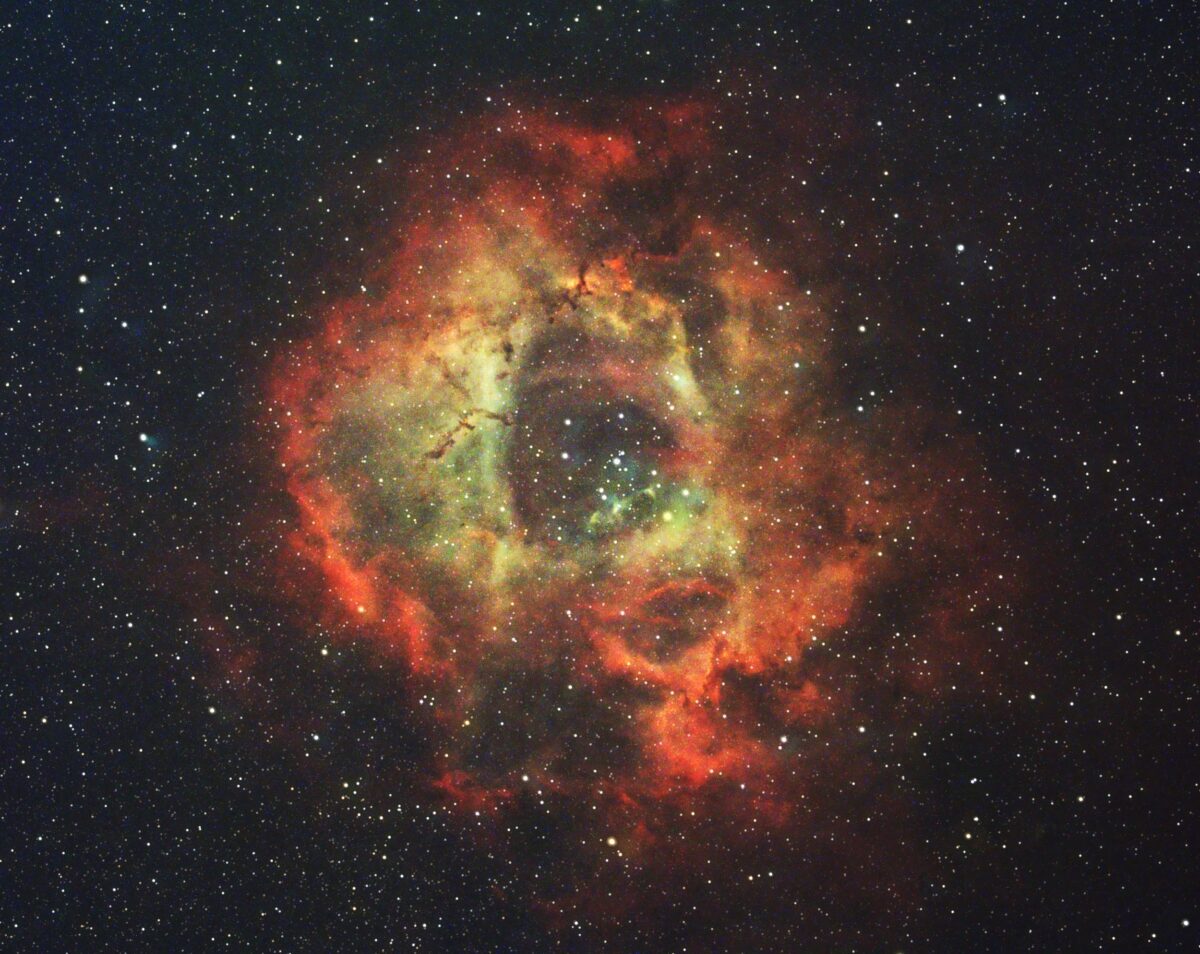
The Rosette Nebula, about 5000 light-years from Earth, is near one end of a giant molecular cloud in the Monoceros region of the Milky Way. The open cluster NGC 2244 is closely associated with the nebulosity, the stars of the cluster having been formed from the nebula’s matter. Photo: MPAS member Chris Kostokanellis
Highlights this month
- 5ThuThe Moon passes Venus — 5° apart. (9:03pm)
- 6FriMercury in inferior conjunction with the Sun — lost in the glare. (1:13pm)
- 8SunJupiter at opposition — closest and brightest of the year, up all night in Taurus (mag −2.7). (8:01am)
- 8SunMars is stationary — begins retrograde (westward) motion. (8:52am)
- 8SunNeptune is stationary — resumes direct (eastward) motion. (6:14pm)
- 8SunThe Moon passes Saturn — 1° apart. (9:09pm)
- 14SatGeminids meteor shower peaks (up to 150/hr). A bright 98% Moon interferes badly this year.
- 16MonMercury is stationary — resumes direct (eastward) motion. (8:07am)
- 19ThuThe Moon passes Mars — 3° apart. (12:08am)
- 21SatSummer solstice.
- 22SunUrsids meteor shower peaks (up to 10/hr). A 57% Moon washes out fainter meteors for part of the night.
- 25WedMercury at greatest morning elongation (22° from the Sun, mag −0.4) — best morning apparition. (1:24pm)
If you are observing the sky with binoculars, there is a great deal to see looking south this month. NGC 3114 and NGC 2516 are both prominent open clusters worth observing in Carina in the south-east. The Eta Carina Nebula, or NGC 3372, is a bright diffuse nebula visible through binoculars or a small telescope. The bright open cluster IC 2602, or the Southern Pleiades, is a great binocular object. Also look out for the Small Magellanic Cloud in Tucana, and the Large Magellanic Cloud sitting on the border of the constellations Mensa and Dorado. A small telescope will show star clusters and bright patches of nebulosity within it, including the Tarantula Nebula, or NGC 2070, in the LMC.
During December the constellations Taurus, Gemini, Orion and Auriga are visible. Looking towards the north you can see the distinct upside down ‘V’ shape of the Hyades open star cluster, which marks the head of the constellation Taurus. Within Taurus you can also observe the open star cluster Pleiades, or M45, which can be seen with the naked eye and is a wonderful sight through a small telescope. Just next to it towards the north-east is Orion, a magnificent sight with its bright stars Rigel and Betelgeuse, and the fantastic nebula M42.
On the night of December 14 we have the Geminids, considered one of the most spectacular meteor showers of the year. The shower owes its name to the constellation Gemini because the meteors seem to emerge from this constellation in the sky. Unlike most other meteor showers, the Geminids are not associated with a comet but with an asteroid called 3200 Phaethon. As Earth passes through a massive trail of dusty debris shed by the weird, rocky object, the dust and grit burn up in a flurry of shooting stars as they run into Earth’s atmosphere. The asteroid takes about 1.4 years to orbit the sun.
December’s conjunctions, which is when two astronomical objects appear close to each other in the sky, include the moon and Venus on December 5, the moon and Saturn on December 8, the moon and Jupiter on December 15, and the moon and Mars on December 18. And on December 21 the Earth is at solstice, which is when the axis is tilted most closely towards the sun and the southern hemisphere sees its longest day.
By Nerida Langcake
This article appeared in the December 2024 issue of the Mornington Peninsula Magazine.
The sky in detail — December 2024
Sun & twilight
| Date | Sunrise | Sunset | Day length | Astro. dark begins | ends |
|---|---|---|---|---|---|
| Sun 1 | 5:50am | 8:28pm | 14h 37m | 10:20pm | 3:58am |
| Tue 10 | 5:50am | 8:36pm | 14h 46m | 10:31pm | 3:55am |
| Fri 20 | 5:52am | 8:42pm | 14h 50m | 10:39pm | 3:56am |
| Tue 31 | 5:59am | 8:46pm | 14h 47m | 10:42pm | 4:03am |
Days lengthen by about 10 minutes over the month.
The Moon
- New MoonSun 1, 5:26pm
- First QuarterMon 9, 2:30am
- Full MoonSun 15, 8:00pm
- Last QuarterMon 23, 9:21am
- New MoonTue 31, 9:32am
Perigee 12 Dec (365,500 km) · Apogee 24 Dec (404,900 km)
The planets
Rise/set for mid-month at The Briars.
| Planet | In | Mag | Rise | Transit | Set | Best |
|---|---|---|---|---|---|---|
| Mercury | Sco | 0.4 | 5:00am | 12:04pm | 7:07pm | Hidden |
| Venus | Cap | −4.2 | 9:20am | 4:31pm | 11:41pm | Evening |
| Mars | Cnc | −0.8 | 11:28pm | 4:20am | 9:09am | Morning |
| Jupiter | Tau | −2.6 | 7:49pm | 12:42am | 5:30am | All night |
| Saturn | Aqr | 0.9 | 12:16pm | 6:44pm | 1:16am | Evening |
| Uranus | Tau | 5.7 | 6:08pm | 11:09pm | 4:14am | Evening |
| Neptune | Psc | 7.8 | 1:24pm | 7:33pm | 1:47am | Evening |
Meteor showers
- Geminids — peaks 14 December, radiant in Gemini (up to 150/hr). The richest shower of the year; the radiant reaches a useful altitude after local midnight, so it rewards southern observers well. A bright 98% Moon interferes badly this year.
- Ursids — peaks 22 December, radiant in Ursa Minor (up to 10/hr). A circumpolar northern shower whose radiant never rises from Victoria. A 57% Moon washes out fainter meteors for part of the night.
Computed for The Briars, Mt Martha. Times are local (Melbourne).
Generated automatically from the MPAS sky engine on 21 September 2026.
The solar system — December 2024
Evening sky Morning sky Up much of the night Lost in the Sun’s glare
Open the full interactive orrery ↗ — fast-forward, pick any date, toggle the Moon and more.
Looking for an earlier month? Browse all past monthly guides →