
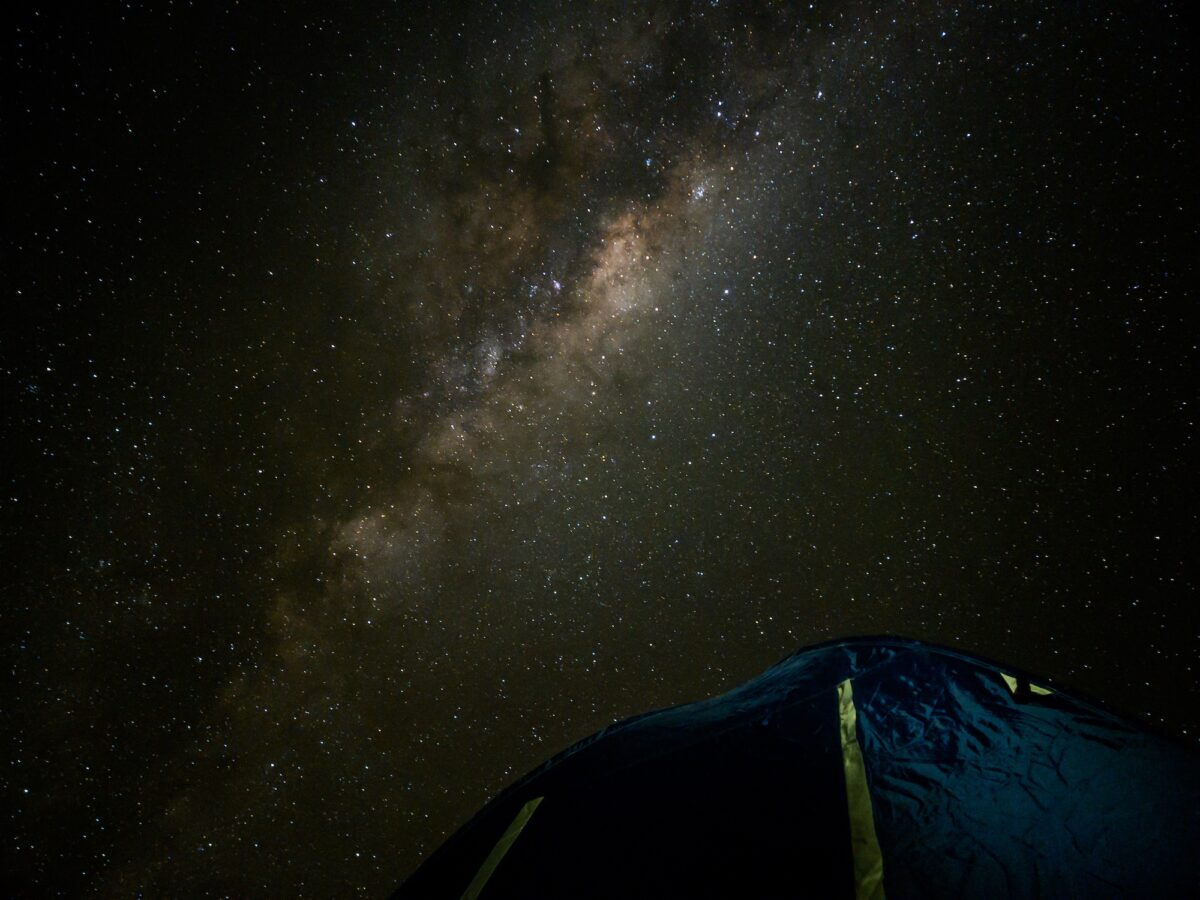
This single 30-second image of the Milky Way was taken at ISO1600 with a smartphone leaning against a drink bottle under beautiful dark skies. You don’t always need fancy equipment to capture what’s right in front of you. Photo: MPAS member Nerida Langcake
Highlights this month
- 8WedNeptune is stationary — begins retrograde (westward) motion. (9:43am)
- 13MonMercury in inferior conjunction with the Sun — lost in the glare. (11:24am)
- 17FriThe Moon passes Venus — 4° apart. (8:08pm)
- 24FriMercury is stationary — resumes direct (eastward) motion. (3:07am)
- 28TueSaturn is stationary — begins retrograde (westward) motion. (7:57am)
- 29WedJupiter in superior conjunction with the Sun — lost in the glare. (10:24pm)
- 30ThuSouthern Delta Aquariids meteor shower peaks (up to 25/hr). A bright 100% Moon interferes badly this year.
- 30ThuAlpha Capricornids meteor shower peaks (up to 5/hr). A bright 100% Moon interferes badly this year.
Looking north in July, the wonderful globular cluster M5 is high in the sky. It is roughly 25,000 light-years away from Earth, towards the constellation Serpens Caput. A small telescope brings many of its outer stars into focus. A short hop east over Ophiuchus into Serpens Cauda and you will find the open cluster M16 surrounded by the much fainter Eagle Nebula.
Sitting high in the southern skies, Scorpius is easy to spot this month. Nearby is the constellation Sagittarius, which is famous for the ‘Teapot’ asterism formed by some of its brightest stars. When you look towards Sagittarius and Scorpius, you are peering towards the centre of the Milky Way galaxy. This whole region is full of rich and beautiful star fields that are great to explore using binoculars.
At this time of the year the constellation Sagittarius offers some exceptional deep-sky objects. The globular cluster M22 is visible to the naked eye if you have good observing conditions. The Lagoon Nebula, or M8, lying above the spout of the Teapot, is a glowing cloud of gas. Other famous deep-sky objects in Sagittarius are visible through a telescope, including the Trifid Nebula, or M20. Beside Sagittarius, Scorpius contains the bright open clusters M6 and M7, which remain high in the sky this month. To the north in the constellation Serpens Cauda, the Tail of the Serpent, lies the open cluster M16 in the much fainter Eagle Nebula.
By Nerida Langcake
The sky in detail — July 2026
Sun & twilight
| Date | Sunrise | Sunset | Day length | Astro. dark begins | ends |
|---|---|---|---|---|---|
| Wed 1 | 7:37am | 5:10pm | 9h 33m | 6:45pm | 6:03am |
| Fri 10 | 7:36am | 5:15pm | 9h 39m | 6:49pm | 6:02am |
| Mon 20 | 7:31am | 5:22pm | 9h 51m | 6:55pm | 5:58am |
| Fri 31 | 7:22am | 5:31pm | 10h 08m | 7:02pm | 5:51am |
Days lengthen by about 36 minutes over the month.
The Moon
- Last QuarterWed 8, 5:34am
- New MoonTue 14, 7:46pm
- First QuarterTue 21, 9:10pm
- Full MoonThu 30, 12:37am
Perigee 13 Jul (358,700 km) · Apogee 26 Jul (405,800 km)
The planets
Rise/set for mid-month at The Briars.
| Planet | In | Mag | Rise | Transit | Set | Best |
|---|---|---|---|---|---|---|
| Mercury | Gem | 5.8 | 7:04am | 12:09pm | 5:15pm | Hidden |
| Venus | Leo | −4.0 | 9:51am | 3:21pm | 8:51pm | Evening |
| Mars | Tau | 1.3 | 4:39am | 9:28am | 2:17pm | Morning |
| Jupiter | Cnc | −1.6 | 8:14am | 1:10pm | 6:07pm | Hidden |
| Saturn | Psc | 0.6 | 11:52pm | 5:47am | 11:37am | Morning |
| Uranus | Tau | 5.8 | 4:06am | 8:58am | 1:51pm | Morning |
| Neptune | Psc | 7.8 | 11:03pm | 5:07am | 11:08am | Morning |
Meteor showers
- Southern Delta Aquariids — peaks 30 July, radiant in Aquarius (up to 25/hr). A favourite southern shower with a high radiant — steady rates through the small hours; overlaps the Alpha Capricornids. A bright 100% Moon interferes badly this year.
- Alpha Capricornids — peaks 30 July, radiant in Capricornus (up to 5/hr). Low rates but noted for slow, bright fireballs; radiant well placed from the south. A bright 100% Moon interferes badly this year.
Computed for The Briars, Mt Martha. Times are local (Melbourne).
Generated automatically from the MPAS sky engine on 19 October 2026.
The solar system — July 2026
Evening sky Morning sky Up much of the night Lost in the Sun’s glare
Open the full interactive orrery ↗ — fast-forward, pick any date, toggle the Moon and more.
Looking for an earlier month? Browse all past monthly guides →