
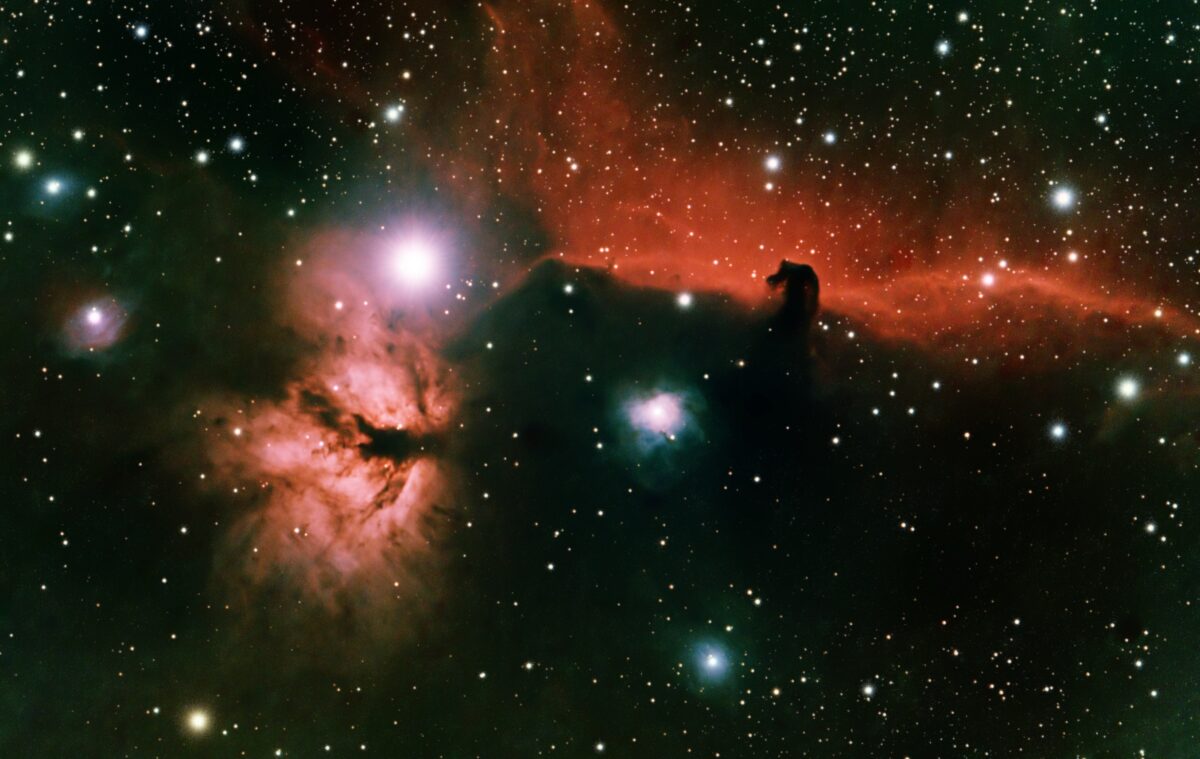
One of most recognisable sights in the night sky, the aptly named Horsehead Nebula – also known as Barnard 33 – is a small dark nebula in the constellation Orion about 1375 light-years from Earth. It’s located just to the south of Alnitak, the easternmost star of Orion’s Belt, and is part of the much larger Orion Molecular Cloud Complex. To its left is the Flame Nebula, designated NGC 2024 and Sh2-277. An emission nebula in Orion, it is 900-1500 light-years away. Photo: MPAS member Guido Tack
Highlights this month
- 1TueThe Moon passes Mercury — 3° apart. (6:34am)
- 3ThuMercury and Saturn in conjunction — 0.7° apart. (5:41am)
- 6SunJupiter in superior conjunction with the Sun — lost in the glare. (1:17am)
- 13SunNeptune in superior conjunction with the Sun — lost in the glare. (10:58pm)
- 16WedVenus and Mars in conjunction — 4° apart. (6:50am)
- 20SunVenus at greatest morning elongation (47° from the Sun, mag −4.4) — best morning apparition. (9:08pm)
- 21MonAutumn equinox.
- 29TueThe Moon passes Saturn — 5° apart. (4:19am)
- 29TueVenus and Saturn in conjunction — 2° apart. (7:03am)
The constellation Orion is gradually sinking out of view, so make the most of it before it disappears. Leo is very much still on show and can be found sitting high in the northern part of the sky. Not far away from Leo, a little lower in the northwest, are the brightest stars of the constellation Gemini, Castor and Pollux.
See if you can find the False Cross which is formed by four stars in the constellations Carina and Vela. The False Cross asterism resembles the constellation Crux, the Southern Cross, but is somewhat larger. The constellation Vela, the Sails, was once part of a larger constellation called Argo Navis, the Ship. Vela can be found near the other parts of the ship, notably the constellations Carina, the Keel, and Puppis, the Stern.
With a good pair of binoculars, you can view the open cluster known as the Southern Pleiades (IC 2602). Just north of the Southern Pleiades is the glowing region NGC 3372 that’s visible to the unaided eye. Also known as the Carina Nebula, it is beautiful when observed through a small telescope.
This month we will see a few conjunctions, starting with Venus and Mars on March 13. Then on March 28 is a conjunction of the moon, Venus, Mars and Saturn, followed by a conjunction of Venus and Saturn on March 30.
The Mornington Peninsula Astronomical Society is holding a Musical Stargazing Night on Saturday, March 26. The event is a fundraiser for the Cranbourne Lions Concert Band and MPAS, so all attendees over the age of 16 will need tickets. Buy yours via our website at www.mpas.asn.au/special-events. There is a telescope door prize to win, a raffle, an astronomy talk about humans in space, and answers to questions you probably never considered, as well as a trivia contest including music, astronomy and general knowledge questions. It’s at the Mount Martha Observatory at The Briars. Tickets are limited and bookings are necessary, so don’t miss out.
By Nerida Langcake
This article appeared in the March 2022 issue of the Mornington Peninsula Magazine.
The sky in detail — March 2022
Sun & twilight
| Date | Sunrise | Sunset | Day length | Astro. dark begins | ends |
|---|---|---|---|---|---|
| Tue 1 | 7:03am | 8:00pm | 12h 57m | 9:32pm | 5:31am |
| Thu 10 | 7:13am | 7:47pm | 12h 35m | 9:17pm | 5:42am |
| Sun 20 | 7:22am | 7:32pm | 12h 10m | 9:00pm | 5:54am |
| Thu 31 | 7:33am | 7:15pm | 11h 42m | 8:43pm | 6:05am |
Days shorten by about 75 minutes over the month.
The Moon
- New MoonThu 3, 4:34am
- First QuarterThu 10, 9:51pm
- Full MoonFri 18, 6:23pm
- Last QuarterFri 25, 4:40pm
Apogee 11 Mar (404,800 km) · Perigee 24 Mar (369,800 km)
The planets
Rise/set for mid-month at The Briars.
| Planet | In | Mag | Rise | Transit | Set | Best |
|---|---|---|---|---|---|---|
| Mercury | Aqr | −0.5 | 5:53am | 12:31pm | 7:09pm | Hidden |
| Venus | Cap | −4.5 | 3:34am | 10:28am | 5:22pm | Morning |
| Mars | Cap | 1.2 | 3:18am | 10:26am | 5:34pm | Morning |
| Jupiter | Aqr | −1.9 | 6:43am | 1:04pm | 7:25pm | Hidden |
| Saturn | Cap | 0.7 | 4:29am | 11:22am | 6:14pm | Morning |
| Uranus | Ari | 5.9 | 11:15am | 4:28pm | 9:41pm | Evening |
| Neptune | Psc | 7.9 | 7:11am | 1:25pm | 7:39pm | Hidden |
Computed for The Briars, Mt Martha. Times are local (Melbourne).
Generated automatically from the MPAS sky engine on 24 October 2026.
The solar system — March 2022
Evening sky Morning sky Up much of the night Lost in the Sun’s glare
Open the full interactive orrery ↗ — fast-forward, pick any date, toggle the Moon and more.
Looking for an earlier month? Browse all past monthly guides →