
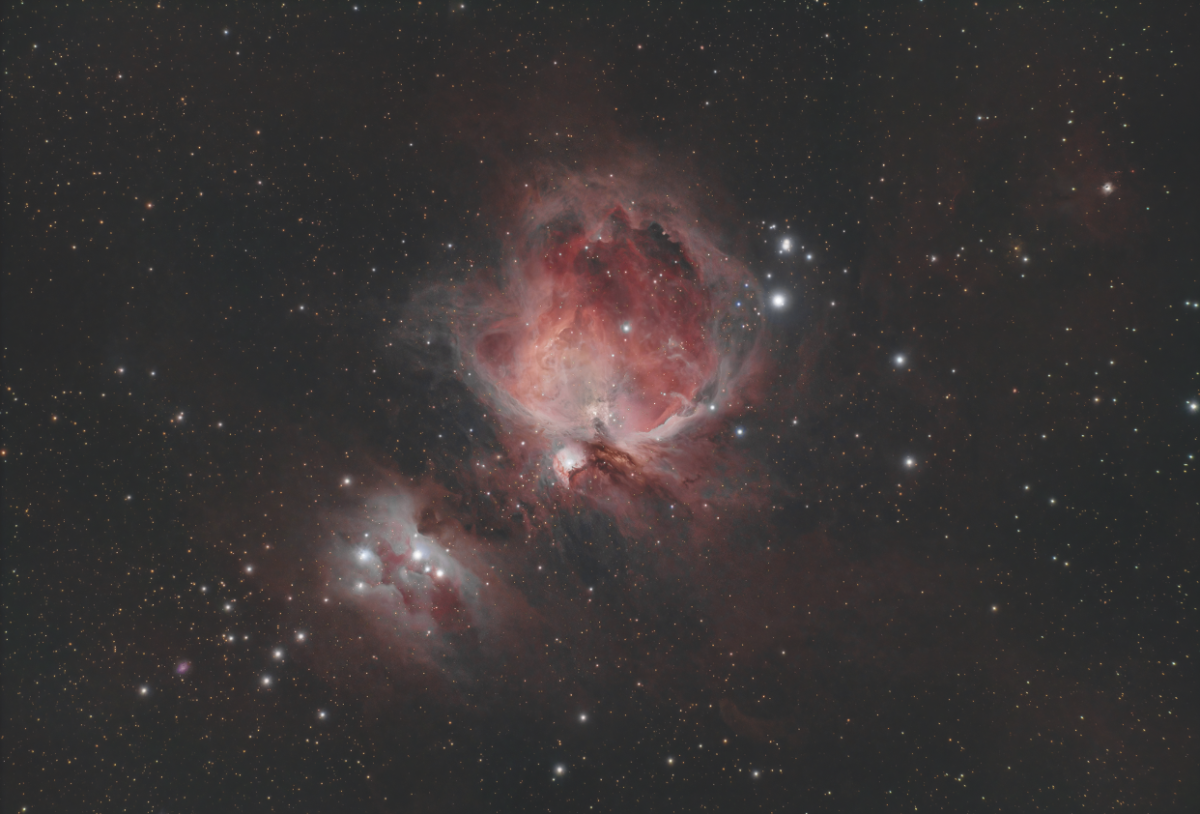
M42, the Orion Nebula, is one of the brightest nebulae and is visible to the naked eye in the night sky. Lying about 1350 light-years away, it can be found up above Orion’s Belt in the constellation of Orion. Photo by MPAS member Nik Axaris
Highlights this month
- 9TueMercury in inferior conjunction with the Sun — lost in the glare. (12:43am)
- 19FriThe Moon passes Mars — 5° apart. (8:42pm)
- 20SatMercury is stationary — resumes direct (eastward) motion. (11:21pm)
- 24WedMercury and Saturn in conjunction — 4° apart. (5:34am)
The two brightest stars in the sky this month are Sirius and Canopus. And two stunning constellations – Crux the Southern Cross, and Centaurus the Centaur – are also visible. A little way above them you will find the deceptive False Cross, sometimes mistaken for the true Southern Cross. The False Cross is formed by four stars in Vela and Carina.
Still looking south, you can find the South Celestial Pole by intersecting two imaginary lines: one an extension of the long axis of Crux, and the other at a right angle to the line joining the two pointer stars, Alpha and Beta Centauri.
At this time of the year, the two main stars of Gemini, Castor and Pollux, can be found sitting in the north. The constellations Orion and Taurus are also on show. In the south you will find the Large and Small Magellanic Clouds. Meanwhile, Leo the Lion is steadily rising in the northeast.
The constellation Puppis the Stern sits in the night sky just north of the bright star Canopus and is wedged between the constellations Vela, Carina and Canis Major. Puppis is home to the open star clusters M46 and M47, which can be seen with a pair of binoculars. Mars is also visible in the night sky, positioned near the first quarter moon on February 19, then within binocular distance of the Pleiades cluster – aka M45 or the Seven Sisters – on February 28.
The Mornington Peninsula Astronomical Society holds its monthly public stargazing night on the first Friday of each month at the MPAS Mount Martha Observatory at The Briars. It starts at 8pm with a multimedia talk and Q&A before moving outside to view the moon, planets, stars and clusters, all through a wide array of telescopes supplied by the society and members. These nights are great fun for the whole family. Tickets are limited and bookings are necessary, so don’t miss out!
By Nerida Langcake
This article appeared in the February 2021 issue of the Mornington Peninsula Magazine.
The sky in detail — February 2021
Sun & twilight
| Date | Sunrise | Sunset | Day length | Astro. dark begins | ends |
|---|---|---|---|---|---|
| Mon 1 | 6:32am | 8:34pm | 14h 01m | 10:16pm | 4:50am |
| Wed 10 | 6:43am | 8:25pm | 13h 42m | 10:03pm | 5:04am |
| Sat 20 | 6:54am | 8:12pm | 13h 18m | 9:47pm | 5:19am |
| Sun 28 | 7:03am | 8:01pm | 12h 59m | 9:34pm | 5:30am |
Days shorten by about 62 minutes over the month.
The Moon
- Last QuarterFri 5, 4:43am
- New MoonFri 12, 6:06am
- First QuarterSat 20, 5:47am
- Full MoonSat 27, 7:23pm
Perigee 4 Feb (369,800 km) · Apogee 18 Feb (404,900 km)
The planets
Rise/set for mid-month at The Briars.
| Planet | In | Mag | Rise | Transit | Set | Best |
|---|---|---|---|---|---|---|
| Mercury | Cap | 2.2 | 5:53am | 12:38pm | 7:23pm | Hidden |
| Venus | Cap | −3.7 | 5:59am | 12:57pm | 7:56pm | Hidden |
| Mars | Ari | 0.7 | 1:49pm | 6:48pm | 11:47pm | Evening |
| Jupiter | Cap | −1.8 | 5:43am | 12:43pm | 7:42pm | Hidden |
| Saturn | Cap | 0.6 | 5:11am | 12:16pm | 7:21pm | Hidden |
| Uranus | Ari | 5.8 | 12:39pm | 5:58pm | 11:16pm | Evening |
| Neptune | Aqr | 7.9 | 8:44am | 3:02pm | 9:20pm | Hidden |
Computed for The Briars, Mt Martha. Times are local (Melbourne).
Generated automatically from the MPAS sky engine on 20 September 2026.
The solar system — February 2021
Evening sky Morning sky Up much of the night Lost in the Sun’s glare
Open the full interactive orrery ↗ — fast-forward, pick any date, toggle the Moon and more.
Looking for an earlier month? Browse all past monthly guides →