
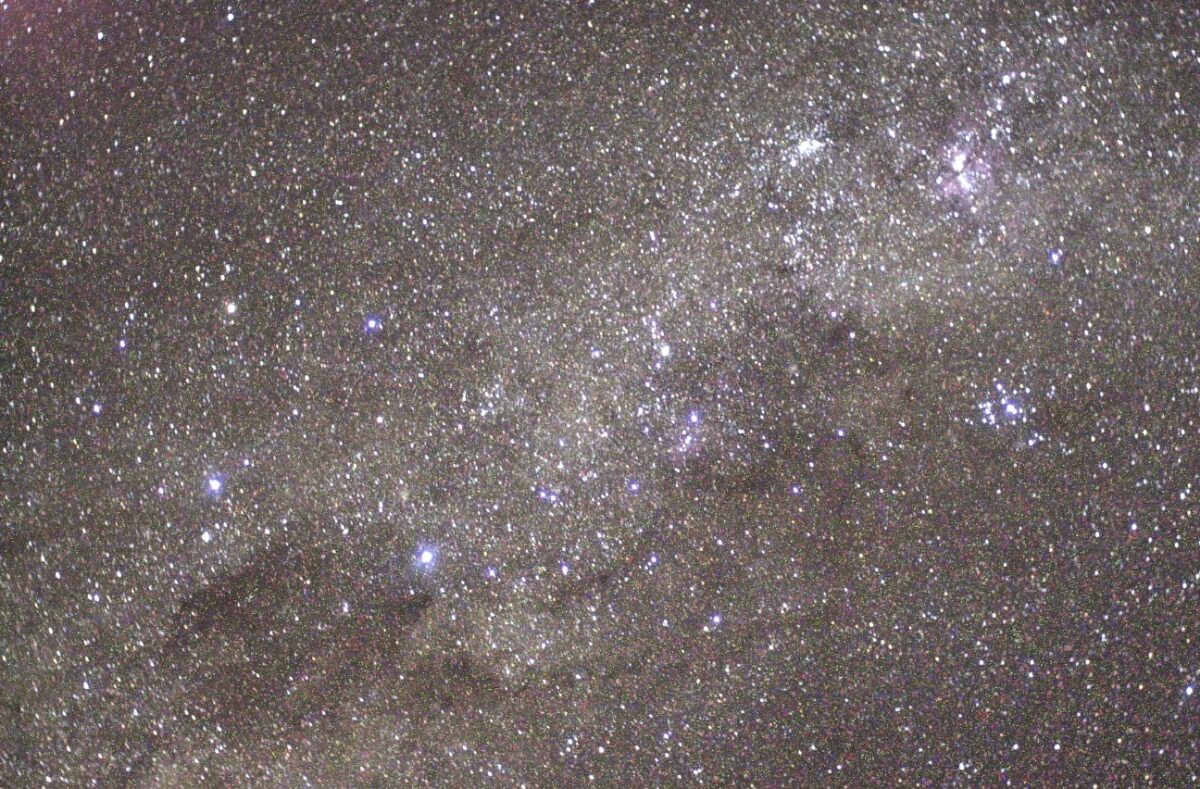
Taken from the ISS, this photo of Crux – the Southern Cross – shows the Coalsack Nebula in the lower left. Courtesy NASA
Highlights this month
- 1WedMars and Saturn in conjunction — 0.9° apart. (3:32am)
- 15WedThe Moon passes Jupiter — 2° apart. (9:33am)
- 15WedThe Moon passes Saturn — 2° apart. (8:00pm)
- 16ThuThe Moon passes Mars — 2° apart. (3:29pm)
- 23ThuLyrids meteor shower peaks (up to 18/hr). A thin 0% Moon leaves the sky dark.
- 26SunUranus in superior conjunction with the Sun — lost in the glare. (7:45pm)
April is the perfect time of the year for observing the dark nebula known as the Coalsack. You will find it nestled within the rich, bright star fields of the Milky Way. It is visible to the naked eye, sitting right next to Crux – the Southern Cross. The Coalsack appears dark because it stops the light from the stars behind it reaching our eyes.
While looking at the constellation Crux, observe the bright star Acrux, which is a multiple star and can be resolved by a small telescope. An interesting fact is that out of all the constellations, Crux is the smallest. The whole constellation should fit behind your outstretched hand at arm’s length.
Then not far from the Coalsack you will find the wonderful open cluster NGC 4755, the Jewel Box Cluster. It looks like a hazy star to the naked eye, but binoculars or a small telescope will reveal its individual, colourful twinkling stars. If you are observing with binoculars, make sure you do not miss two marvellous sights in the nearby constellation Carina: IC 2602, the Southern Pleiades, and NGC 3372, the Carina Nebula.
On April 1, Saturn will be close to Mars in the morning sky, then on April 3-4 Venus passes through the Pleiades cluster. On April 8 we will see a perigee full moon – the moon’s closest point to Earth in its monthly orbit – also referred to as a ‘super moon’. One week later on April 15, the waning moon will be close to Jupiter in the morning sky, followed on April 16 with the waning moon close to Saturn in the morning sky. Then on April 26-27 we will see the crescent moon near Venus in the evening sky.
By Nerida Langcake
This article appeared in the April 2020 issue of the Mornington Peninsula Magazine.
The sky in detail — April 2020
Sun & twilight
| Date | Sunrise | Sunset | Day length | Astro. dark begins | ends |
|---|---|---|---|---|---|
| Wed 1 | 7:34am | 7:13pm | 11h 39m | 8:40pm | 6:06am |
| Fri 10 | 6:42am | 5:59pm | 11h 17m | 7:27pm | 5:14am |
| Mon 20 | 6:52am | 5:45pm | 10h 54m | 7:14pm | 5:23am |
| Thu 30 | 7:01am | 5:33pm | 10h 32m | 7:02pm | 5:31am |
Days shorten by about 67 minutes over the month.
The Moon
- First QuarterWed 1, 9:26pm
- Full Moon SupermoonWed 8, 12:34pm
- Last QuarterWed 15, 9:00am
- New MoonThu 23, 12:27pm
Perigee 8 Apr (356,800 km) · Apogee 21 Apr (406,200 km)
The planets
Rise/set for mid-month at The Briars.
| Planet | In | Mag | Rise | Transit | Set | Best |
|---|---|---|---|---|---|---|
| Mercury | Psc | −0.4 | 5:09am | 11:12am | 5:14pm | Hidden |
| Venus | Tau | −4.5 | 10:41am | 3:13pm | 7:45pm | Evening |
| Mars | Cap | 0.6 | 12:34am | 7:39am | 2:44pm | Morning |
| Jupiter | Sgr | −2.0 | 11:21pm | 6:37am | 1:50pm | Morning |
| Saturn | Cap | 0.5 | 11:48pm | 7:00am | 2:09pm | Morning |
| Uranus | Ari | 5.9 | 7:40am | 1:00pm | 6:20pm | Hidden |
| Neptune | Aqr | 7.9 | 3:52am | 10:09am | 4:27pm | Morning |
Meteor showers
- Lyrids — peaks 23 April, radiant in Lyra (up to 18/hr). A modest shower; the radiant is low in the north-east before dawn from Victoria. A thin 0% Moon leaves the sky dark.
Computed for The Briars, Mt Martha. Times are local (Melbourne).
Generated automatically from the MPAS sky engine on 15 August 2026.
The solar system — April 2020
Evening sky Morning sky Up much of the night Lost in the Sun’s glare
Open the full interactive orrery ↗ — fast-forward, pick any date, toggle the Moon and more.
Looking for an earlier month? Browse all past monthly guides →