
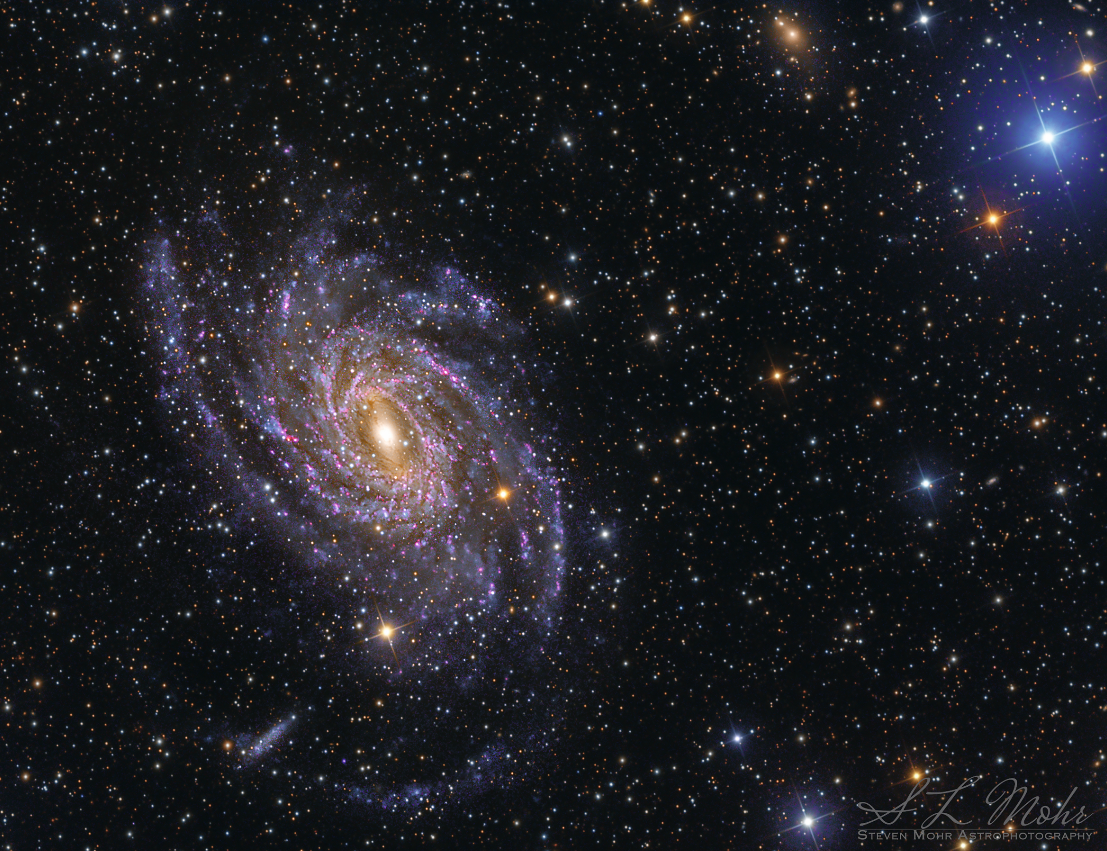
NGC 6744 (aka Caldwell 101) is an intermediate spiral galaxy about 30 million light-years away in the constellation Pavo. It is considered a Milky Way mimic, displaying flocculent (fluffy) arms and an elongated core. It also has at least one distorted companion galaxy – NGC 6744A – superficially similar to one of the Magellanic Clouds. Photo by MPAS member Steven Mohr
Highlights this month
- 1SunUranus at opposition — closest and brightest of the year, up all night in Aries (mag 5.7). (3:10am)
- 3TueMercury is stationary — resumes direct (eastward) motion. (7:15pm)
- 5ThuSouthern Taurids meteor shower peaks (up to 5/hr). A bright 82% Moon interferes badly this year.
- 11WedMercury at greatest morning elongation (19° from the Sun, mag −0.6) — best morning apparition. (3:57am)
- 16MonMars is stationary — resumes direct (eastward) motion. (5:32am)
- 17TueLeonids meteor shower peaks (up to 15/hr). A thin 6% Moon leaves the sky dark.
- 19ThuThe Moon passes Jupiter — 2° apart. (10:12pm)
- 20FriThe Moon passes Saturn — 3° apart. (12:02am)
- 29SunNeptune is stationary — resumes direct (eastward) motion. (5:37pm)
There is a lot to see in the southern skies this month with just the naked eye. Start off by looking for the Large Magellanic Cloud (LMC) west of the constellation Pictor, and the Small Magellanic Cloud (SMC) in Tucana. These are both irregular galaxies close to the Milky Way. The globular cluster 47 Tucanae can be seen with the naked eye as a hazy star very close to the SMC. A large-aperture telescope shows its countless stars packed together in a dense ball.
In the east you can locate Canis Major, which is hard to miss because it is home to the blazing star Sirius. In Canis Major, the open clusters NGC 2362 and M41 make for good small-telescope targets. Also coming into view in the east are Orion and Taurus. It is easy to identify Orion because its brightest stars are blue-white Rigel (Beta Orionis) and red Betelgeuse (Alpha Orionis).
The constellation Eridanus is located above Orion and is one of the largest constellations in the sky. There you will find the interesting multiple star system Omicron-2 Eridani, with three components, and the double star Theta Eridani. Both are visible with small telescopes. Deep-sky observers with dark skies will be able to spot the barred spiral galaxy NGC 1300, located approximately 69 million light-years from Earth, in the same constellation using large telescopes.
The Leonid meteor shower is annually active each November, and this year the Leonids will peak on the night of November 17-18. The shower is called Leonids because its radiant – the point in the sky where the meteors seem to emerge from – lies in the constellation Leo. The Leonids occur when the Earth passes through the debris left by Comet Tempel-Tuttle. The comet takes about 33 years to make one orbit around the sun.
By Nerida Langcake
This article appeared in the November 2020 issue of the Mornington Peninsula Magazine.
The sky in detail — November 2020
Sun & twilight
| Date | Sunrise | Sunset | Day length | Astro. dark begins | ends |
|---|---|---|---|---|---|
| Sun 1 | 6:12am | 7:55pm | 13h 43m | 9:35pm | 4:33am |
| Tue 10 | 6:03am | 8:05pm | 14h 02m | 9:48pm | 4:20am |
| Fri 20 | 5:55am | 8:16pm | 14h 21m | 10:04pm | 4:08am |
| Mon 30 | 5:51am | 8:27pm | 14h 36m | 10:19pm | 3:59am |
Days lengthen by about 53 minutes over the month.
The Moon
- Full MoonSun 1, 1:50am
- Last QuarterMon 9, 12:53am
- New MoonSun 15, 4:13pm
- First QuarterSun 22, 3:45pm
- Full MoonMon 30, 8:30pm
Perigee 14 Nov (357,800 km) · Apogee 27 Nov (405,900 km)
The planets
Rise/set for mid-month at The Briars.
| Planet | In | Mag | Rise | Transit | Set | Best |
|---|---|---|---|---|---|---|
| Mercury | Vir | −0.7 | 5:16am | 11:55am | 6:34pm | Hidden |
| Venus | Vir | −3.8 | 4:41am | 11:06am | 5:31pm | Hidden |
| Mars | Psc | −1.7 | 4:52pm | 10:37pm | 4:27am | Evening |
| Jupiter | Sgr | −1.9 | 10:05am | 5:21pm | 12:41am | Evening |
| Saturn | Sgr | 0.5 | 10:25am | 5:38pm | 12:54am | Evening |
| Uranus | Ari | 5.7 | 6:45pm | 12:03am | 5:25am | All night |
| Neptune | Aqr | 7.8 | 2:39pm | 8:58pm | 3:22am | Evening |
Meteor showers
- Southern Taurids — peaks 5 November, radiant in Taurus (up to 5/hr). Sparse but rich in slow fireballs over a long, broad maximum. A bright 82% Moon interferes badly this year.
- Leonids — peaks 17 November, radiant in Leo (up to 15/hr). Fast meteors; the radiant rises after midnight and is moderate from the south. A thin 6% Moon leaves the sky dark.
Computed for The Briars, Mt Martha. Times are local (Melbourne).
Generated automatically from the MPAS sky engine on 20 September 2026.
The solar system — November 2020
Evening sky Morning sky Up much of the night Lost in the Sun’s glare
Open the full interactive orrery ↗ — fast-forward, pick any date, toggle the Moon and more.
Looking for an earlier month? Browse all past monthly guides →