
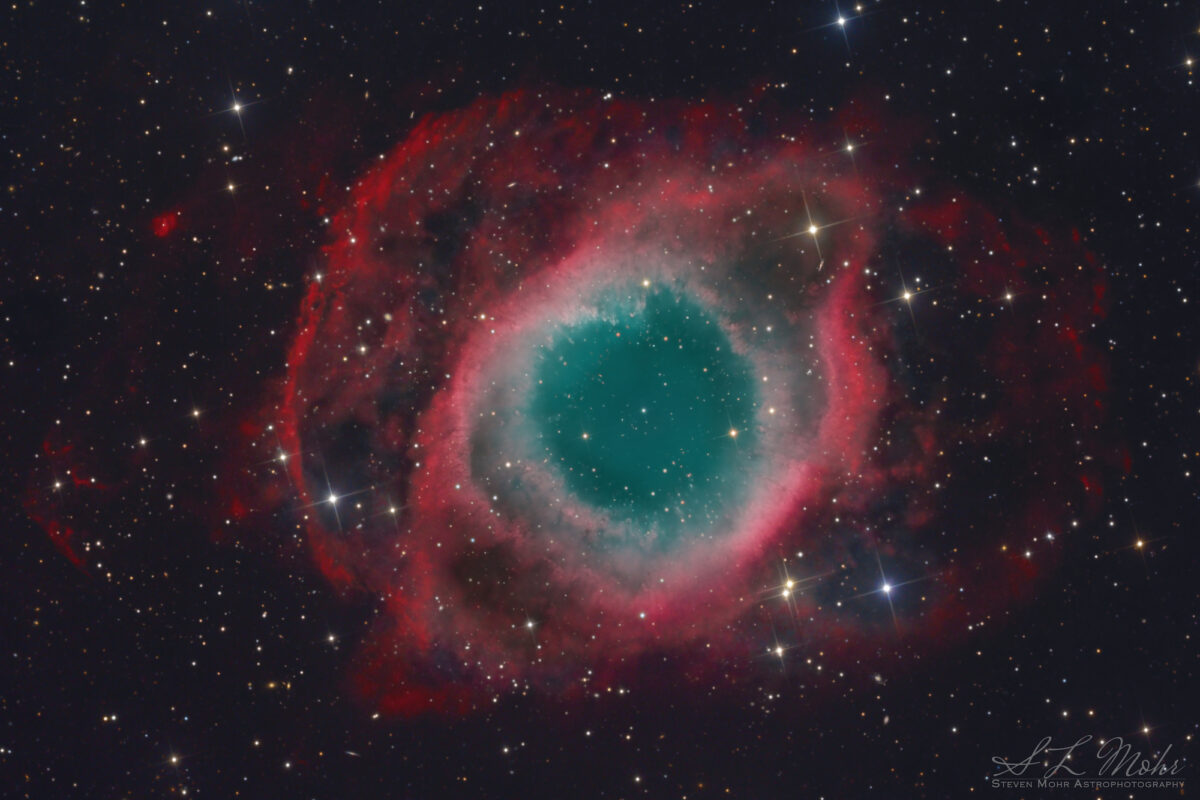
The Helix Nebula, also known as NGC 7293, is a planetary nebula located in the constellation Aquarius. At 650 light-years away, this is one of our closest bright planetary nebulae. Photo by MPAS member Steven Mohr.
Highlights this month
- 10FriThe Moon passes Venus — 4° apart. (6:33pm)
- 14TueMercury at greatest evening elongation (27° from the Sun, mag 0.1) — best evening apparition. (2:11pm)
- 14TueNeptune at opposition — closest and brightest of the year, up all night in Pisces (mag 7.8). (7:25pm)
- 17FriThe Moon passes Saturn — 5° apart. (6:40pm)
- 18SatThe Moon passes Jupiter — 4° apart. (6:39pm)
- 23ThuSpring equinox.
- 27MonMercury is stationary — begins retrograde (westward) motion. (2:10pm)
Be sure to enjoy the rich regions of Scorpius and Ophiuchus this month before they sink below the western horizon. Just above them lies an area around the heart of the Milky Way that’s brimming with star clusters and bright nebulae. In contrast, the eastern half of the sky is relatively empty, although you can still find several constellations, including Pisces, the Fishes; Cetus, the Whale; and Eridanus, the River.
Lying in the constellation Tucana, the Small Magellanic Cloud (SMC) can be found close to the beautiful globular cluster 47 Tucanae, also known as NGC 104, which is a must-see target in the September southern skies. It is visible to the naked eye as a hazy star, while a small telescope shows its bright centre and many of its glittering stars. This cluster is 15,000 light-years away. Other visible targets include the globular clusters M22 in Sagittarius, NGC 6397 in Ara, and M4 in Scorpius. The open clusters M6 and M7 in Scorpius are also visible.
There are a few interesting targets at the moment in Aquarius. The globular cluster M2 appears as a fuzzy star through binoculars and is near the star Beta Aquarii. And the planetary nebula NGC 7293, the Helix Nebula, appears as a faint fuzzy disc through a small telescope. Another globular cluster, M15 in Pegasus, is thought to be 13.2 billion years old and can be picked out with binoculars, while a small telescope shows it clearly.
On September 9, Mercury and the crescent moon will be close together in the evening sky. On September 10, the crescent moon and Venus nearby form a triangle with the bright star Spica. Then on September 17 the waxing moon is near Saturn, and the next night is near Jupiter. On September 23 the Earth is at Equinox, which is when the sun shines directly on the equator and the length of day and night is nearly equal.
By Nerida Langcake
This article appeared in the September 2021 issue of the Mornington Peninsula Magazine.
The sky in detail — September 2021
Sun & twilight
| Date | Sunrise | Sunset | Day length | Astro. dark begins | ends |
|---|---|---|---|---|---|
| Wed 1 | 6:42am | 5:58pm | 11h 16m | 7:26pm | 5:14am |
| Fri 10 | 6:28am | 6:06pm | 11h 37m | 7:34pm | 5:01am |
| Mon 20 | 6:13am | 6:14pm | 12h 02m | 7:43pm | 4:45am |
| Thu 30 | 5:57am | 6:23pm | 12h 26m | 7:53pm | 4:28am |
Days lengthen by about 70 minutes over the month.
The Moon
- New MoonTue 7, 10:59am
- First QuarterTue 14, 6:37am
- Full MoonTue 21, 9:53am
- Last QuarterWed 29, 12:01pm
Perigee 11 Sep (368,200 km) · Apogee 27 Sep (405,100 km)
The planets
Rise/set for mid-month at The Briars.
| Planet | In | Mag | Rise | Transit | Set | Best |
|---|---|---|---|---|---|---|
| Mercury | Vir | 0.2 | 7:14am | 1:49pm | 8:24pm | Evening |
| Venus | Vir | −4.0 | 8:03am | 2:52pm | 9:41pm | Evening |
| Mars | Vir | 1.8 | 6:44am | 12:44pm | 6:45pm | Hidden |
| Jupiter | Cap | −2.6 | 3:39pm | 10:28pm | 5:22am | Evening |
| Saturn | Cap | 0.3 | 2:16pm | 9:21pm | 4:31am | Evening |
| Uranus | Ari | 5.7 | 10:18pm | 3:33am | 8:44am | Morning |
| Neptune | Psc | 7.8 | 5:57pm | 12:16am | 6:32am | All night |
Computed for The Briars, Mt Martha. Times are local (Melbourne).
Generated automatically from the MPAS sky engine on 21 September 2026.
The solar system — September 2021
Evening sky Morning sky Up much of the night Lost in the Sun’s glare
Open the full interactive orrery ↗ — fast-forward, pick any date, toggle the Moon and more.
Looking for an earlier month? Browse all past monthly guides →