
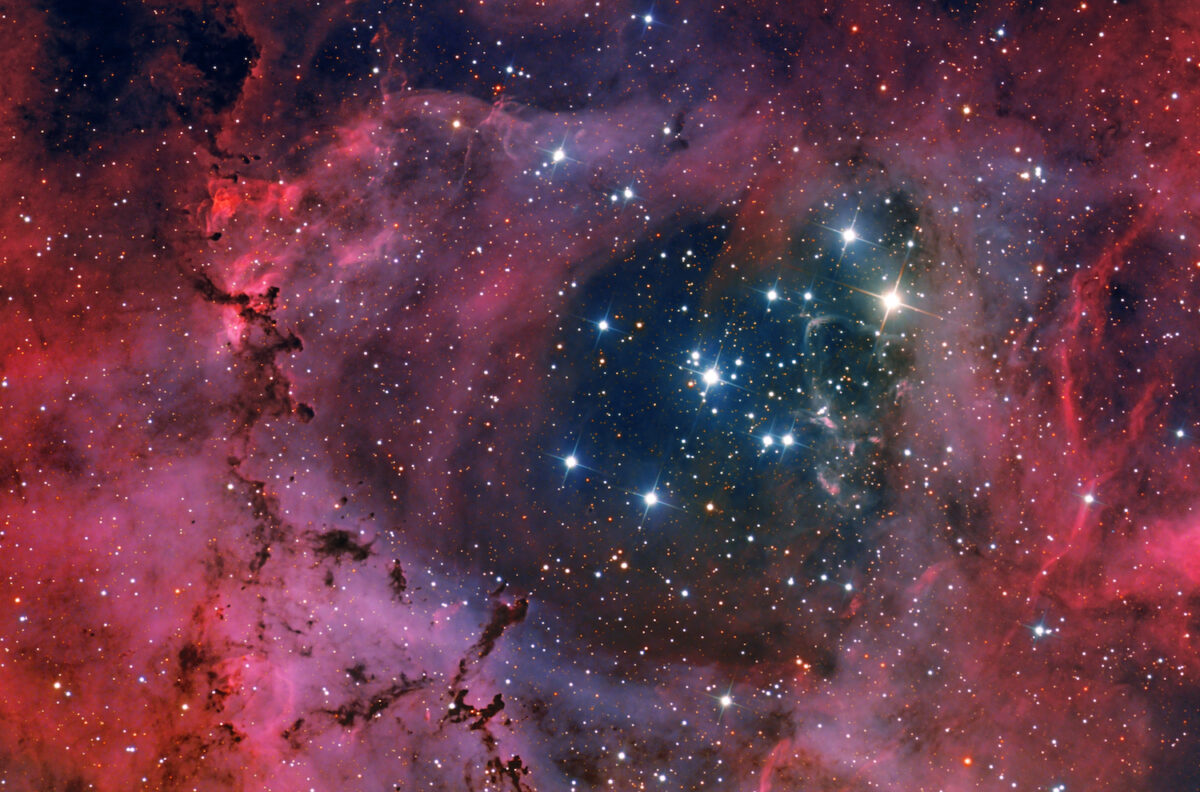
The beautiful Rosette Nebula is a large nebula in the constellation Monoceros. It is a cosmic cloud of gas and dust about 5000 light-years away and has a flower-like appearance. The open cluster NGC 2244 is closely associated with the nebulosity, the stars of the cluster having been formed from the nebula’s matter. This image is a narrow view of the centre region, with lots of dust and gas. Photo: MPAS member Steve Mohr
Highlights this month
- 2ThuNeptune is stationary — resumes direct (eastward) motion. (5:48am)
- 7TueThe Moon passes Venus — 5° apart. (9:08pm)
- 8WedThe Moon passes Saturn — 5° apart. (9:05pm)
- 9ThuThe Moon passes Jupiter — 4° apart. (9:43pm)
- 14TueGeminids meteor shower peaks (up to 150/hr). A bright 80% Moon interferes badly this year.
- 18SatVenus is stationary — begins retrograde (westward) motion. (10:44pm)
- 22WedSummer solstice.
- 22WedUrsids meteor shower peaks (up to 10/hr). A bright 92% Moon interferes badly this year.
The constellations best seen in January are Caelum, Dorado, Lepus, Mensa, Orion, Pictor, Reticulum and Taurus. Two of these constellations – Orion and Taurus – are quite prominent in the evening sky, while others are simply best observed this month. January is the best time of year to observe several famous deep sky objects located in these constellations. The most popular telescope targets include the Orion Nebula (M42), the Crab Nebula (M1), the Pleiades (M45) and Hyades clusters, and the Large Magellanic Cloud.
In the constellation Gemini, the bright star Castor is an interesting target if observed through a telescope. Appearing as a single star to the unaided eye, Castor is actually a multiple star system composed of six stars, three of which can be observed with an amateur telescope.
Sitting at the heels of Orion, the constellation Canis Major – the Greater Dog – is home to Sirius, the brightest star in the entire night sky. Designated Alpha (α) Canis Majoris and known as the ‘dog star’, Sirius is a brilliant white star with a magnitude of -1.4. Canis Major represents one of the two hunting dogs of Orion, the Hunter, which sits nearby. It is home to two fine open clusters, NGC 2362 and M41.
On January 7, Mercury will be at its greatest eastern elongation of 19.2 degrees from the sun. This is the best time to view Mercury because it will be at its highest point above the horizon in the evening sky. Look for the planet low in the western sky just after sunset.
By Nerida Langcake
This article appeared in the January 2022 issue of the Mornington Peninsula Magazine.
The sky in detail — December 2021
Sun & twilight
| Date | Sunrise | Sunset | Day length | Astro. dark begins | ends |
|---|---|---|---|---|---|
| Wed 1 | 5:50am | 8:27pm | 14h 37m | 10:20pm | 3:58am |
| Fri 10 | 5:50am | 8:36pm | 14h 46m | 10:31pm | 3:55am |
| Mon 20 | 5:52am | 8:42pm | 14h 50m | 10:39pm | 3:56am |
| Fri 31 | 5:59am | 8:46pm | 14h 47m | 10:42pm | 4:03am |
Days lengthen by about 10 minutes over the month.
The Moon
- New MoonSat 4, 6:47pm
- First QuarterSat 11, 12:31pm
- Full MoonSun 19, 3:41pm
- Last QuarterMon 27, 1:33pm
Perigee 4 Dec (356,700 km) · Apogee 18 Dec (406,200 km)
The planets
Rise/set for mid-month at The Briars.
| Planet | In | Mag | Rise | Transit | Set | Best |
|---|---|---|---|---|---|---|
| Mercury | Sgr | −0.8 | 6:21am | 1:53pm | 9:26pm | Hidden |
| Venus | Sgr | −4.7 | 8:20am | 3:37pm | 10:53pm | Hidden |
| Mars | Sco | 1.6 | 4:30am | 11:40am | 6:51pm | Hidden |
| Jupiter | Cap | −2.0 | 10:58am | 5:44pm | 12:32am | Evening |
| Saturn | Cap | 0.6 | 9:32am | 4:35pm | 11:38pm | Evening |
| Uranus | Ari | 5.7 | 5:05pm | 10:19pm | 3:37am | Evening |
| Neptune | Aqr | 7.9 | 12:53pm | 7:10pm | 1:31am | Evening |
Meteor showers
- Geminids — peaks 14 December, radiant in Gemini (up to 150/hr). The richest shower of the year; the radiant reaches a useful altitude after local midnight, so it rewards southern observers well. A bright 80% Moon interferes badly this year.
- Ursids — peaks 22 December, radiant in Ursa Minor (up to 10/hr). A circumpolar northern shower whose radiant never rises from Victoria. A bright 92% Moon interferes badly this year.
Computed for The Briars, Mt Martha. Times are local (Melbourne).
Generated automatically from the MPAS sky engine on 19 September 2026.
The solar system — December 2021
Evening sky Morning sky Up much of the night Lost in the Sun’s glare
Open the full interactive orrery ↗ — fast-forward, pick any date, toggle the Moon and more.
Looking for an earlier month? Browse all past monthly guides →