
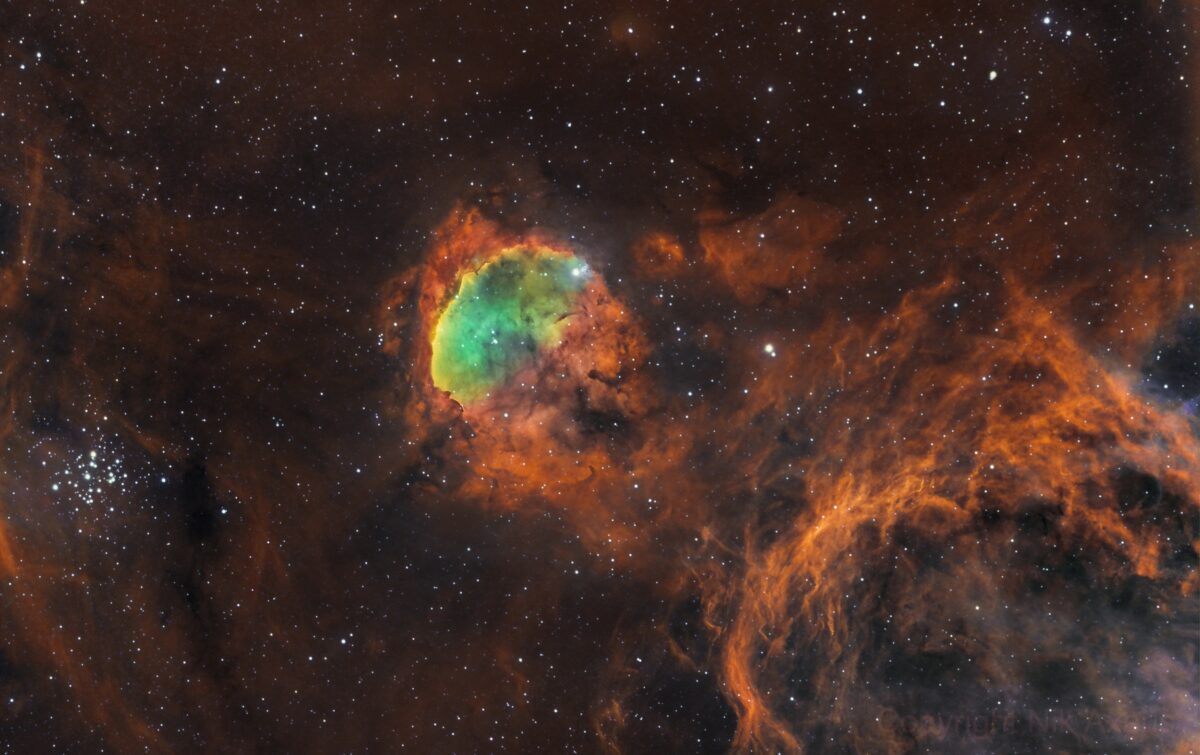
The Gabriela Mistral Nebula (NGC 3324) is an emission nebula located about 7500 light-years from Earth at the northwest corner of the Carina Nebula in the southern constellation of Carina. It covers an area of about 35 light-years and was named due to its resemblance to the Chilean poet. Photo: MPAS member Nick Axaris
Highlights this month
- 3FriMercury is stationary — resumes direct (eastward) motion. (10:29am)
- 5SunSaturn is stationary — begins retrograde (westward) motion. (11:42pm)
- 17FriMercury at greatest morning elongation (23° from the Sun, mag 0.5) — best morning apparition. (12:49am)
- 18SatThe Moon passes Saturn — 4° apart. (10:41pm)
- 21TueWinter solstice.
- 22WedThe Moon passes Jupiter — 2° apart. (1:20am)
- 23ThuThe Moon passes Mars — 0.6° apart. (3:39am)
- 26SunThe Moon passes Venus — 5° apart. (7:06am)
- 29WedNeptune is stationary — begins retrograde (westward) motion. (2:51am)
High in the south in June you will see the constellation Lupus, while the distinctive shape of Scorpius will help you get your bearings. Be sure to scan your eyes across the beautiful star constellation Sagittarius, especially if you are observing from a dark sky site. Looking north, the constellations Boötes, Hercules, and Ophiuchus are on show.
You cannot fail to spot the constellation Scorpius, which has one of the most recognisable patterns in the night sky. It is home to many excellent targets for an amateur telescope, including the marvellous open clusters M6 and M7 found near its tail. Scorpius’s brightest star is the orange-red Antares, which is a supergiant star with a diameter about 800 times that of our own star, the sun.
There are a few conjunctions in June, which is when two astronomical objects appear close to each other in the sky. On June 18 is the conjunction of the moon and Saturn, June 21 the moon and Jupiter, June 23 the moon and Mars, and June 26 the conjunction of the moon and Venus.
On June 5, Saturn enters retrograde motion, which is an apparent change in the movement of the planet through the sky. It is not real, in that the planet does not physically start moving backwards in its orbit. It just appears to do so because of the relative positions of the planet and Earth and how they are moving around the sun.
On June 15, Mercury will be at its highest altitude in the morning sky, then June 22 will see Mercury at dichotomy, which means that half of its Earth-facing side will be illuminated by the sun.
By Nerida Langcake
This article appeared in the June 2022 issue of the Mornington Peninsula Magazine.
The sky in detail — June 2022
Sun & twilight
| Date | Sunrise | Sunset | Day length | Astro. dark begins | ends |
|---|---|---|---|---|---|
| Wed 1 | 7:27am | 5:08pm | 9h 41m | 6:42pm | 5:53am |
| Fri 10 | 7:32am | 5:06pm | 9h 33m | 6:41pm | 5:58am |
| Mon 20 | 7:36am | 5:06pm | 9h 30m | 6:41pm | 6:01am |
| Thu 30 | 7:37am | 5:10pm | 9h 32m | 6:44pm | 6:03am |
Days shorten by about 9 minutes over the month.
The Moon
- First QuarterWed 8, 12:51am
- Full Moon SupermoonTue 14, 9:52pm
- Last QuarterTue 21, 1:11pm
- New MoonWed 29, 12:57pm
Apogee 2 Jun (406,100 km) · Perigee 15 Jun (357,100 km) · Apogee 29 Jun (406,300 km)
The planets
Rise/set for mid-month at The Briars.
| Planet | In | Mag | Rise | Transit | Set | Best |
|---|---|---|---|---|---|---|
| Mercury | Tau | 0.6 | 5:37am | 10:45am | 3:53pm | Morning |
| Venus | Ari | −3.7 | 4:50am | 10:01am | 3:11pm | Morning |
| Mars | Psc | 0.6 | 1:58am | 7:47am | 1:35pm | Morning |
| Jupiter | Psc | −2.1 | 1:12am | 7:10am | 1:09pm | Morning |
| Saturn | Cap | 0.6 | 9:47pm | 4:39am | 11:27am | Morning |
| Uranus | Ari | 5.9 | 4:38am | 9:46am | 2:54pm | Morning |
| Neptune | Psc | 7.9 | 12:21am | 6:32am | 12:43pm | Morning |
Computed for The Briars, Mt Martha. Times are local (Melbourne).
Generated automatically from the MPAS sky engine on 24 October 2026.
The solar system — June 2022
Evening sky Morning sky Up much of the night Lost in the Sun’s glare
Open the full interactive orrery ↗ — fast-forward, pick any date, toggle the Moon and more.
Looking for an earlier month? Browse all past monthly guides →