
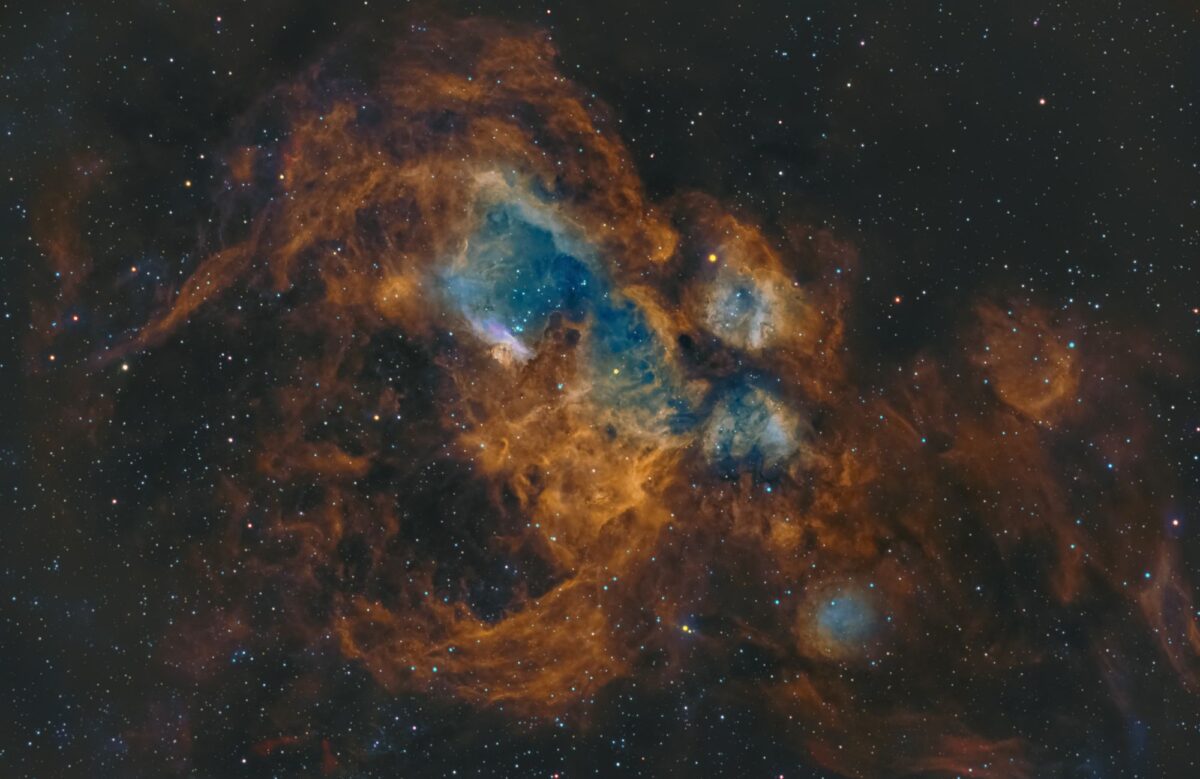
NGC6357, also known as the Lobster Nebula, is located 8000 light-years away in the constellation Scorpius. It is 400 light-years across and is forming some of the most massive stars in the galaxy, but no one is quite sure why that is. Being in the constellation Scorpius means the Lobster Nebula is in the general direction of the centre of the Milky Way. Photo: MPAS member Nick Axaris
Highlights this month
- 12FriThe Moon passes Saturn — 4° apart. (6:23pm)
- 13SatPerseids meteor shower peaks (up to 100/hr). A bright 98% Moon interferes badly this year.
- 15MonSaturn at opposition — closest and brightest of the year, up all night in Capricornus (mag 0.2). (2:52am)
- 15MonThe Moon passes Jupiter — 2° apart. (9:56pm)
- 20SatThe Moon passes Mars — 5° apart. (2:18am)
- 24WedUranus is stationary — begins retrograde (westward) motion. (10:31pm)
- 28SunMercury at greatest evening elongation (27° from the Sun, mag 0.2) — best evening apparition. (2:06am)
Low on the horizon between the stars of Centaurus and Scorpius is the constellation Lupus, the Wolf. In the east the bright star Fomalhaut lies in the constellation Piscis Austrinus, the Southern Fish, and is one of the brightest stars in the sky. Between Fomalhaut and the stars of Scorpius are the stars of the constellations Grus, Tucana, Pavo and Ara. With clear and dark skies you should have little trouble seeing the Small Magellanic Cloud sitting to the west of the Achernar in Eridanus.
Looking north, the constellation Cygnus, the Swan, is home to two open clusters that make good small telescope targets. M29 sits very close to the star Gamma Cygni, officially named Sadr. The magnitude 4.6 cluster M39 can be seen sparkling against the stars of the Milky Way. It has about 30 stars and covers an area of similar size to the full moon and lies 825 light-years away. Higher in the sky you will find Capricornus, the Sea Goat, which is home to the globular cluster M30 and Beta Capricorni – a double star of magnitude 3.1 that can be seen with binoculars.
On August 23, looking between the constellations Capricornus and Aquarius, the asteroid 4 Vesta will be at opposition to the sun and at its closest point to Earth – only 192.3 million kilometres away – which is when it shines at its brightest for the year and is visible through binoculars or a small telescope.
August 27 will see Mercury at its greatest elongation east, which signals the best time to observe the inner planet, as it will be at its greatest distance from the sun and its glare. Then three days later on August 30, Mercury will be at dichotomy, which means that half of its Earth-facing side will be illuminated by the sun.
By Nerida Langcake
This article appeared in the August 2022 issue of the Mornington Peninsula Magazine.
The sky in detail — August 2022
Sun & twilight
| Date | Sunrise | Sunset | Day length | Astro. dark begins | ends |
|---|---|---|---|---|---|
| Mon 1 | 7:21am | 5:31pm | 10h 10m | 7:03pm | 5:50am |
| Wed 10 | 7:12am | 5:39pm | 10h 27m | 7:09pm | 5:42am |
| Sat 20 | 6:59am | 5:48pm | 10h 48m | 7:16pm | 5:31am |
| Wed 31 | 6:44am | 5:57pm | 11h 13m | 7:25pm | 5:16am |
Days lengthen by about 63 minutes over the month.
The Moon
- First QuarterFri 5, 9:07pm
- Full MoonFri 12, 11:34am
- Last QuarterFri 19, 2:42pm
- New MoonSat 27, 6:20pm
Perigee 11 Aug (359,900 km) · Apogee 23 Aug (405,600 km)
The planets
Rise/set for mid-month at The Briars.
| Planet | In | Mag | Rise | Transit | Set | Best |
|---|---|---|---|---|---|---|
| Mercury | Leo | −0.0 | 8:10am | 1:57pm | 7:44pm | Evening |
| Venus | Cnc | −3.7 | 6:15am | 11:12am | 4:10pm | Hidden |
| Mars | Tau | 0.1 | 1:22am | 6:26am | 11:30am | Morning |
| Jupiter | Psc | −2.5 | 9:20pm | 3:20am | 9:16am | Morning |
| Saturn | Cap | 0.2 | 5:30pm | 12:27am | 7:19am | All night |
| Uranus | Ari | 5.8 | 12:47am | 5:53am | 10:59am | Morning |
| Neptune | Psc | 7.8 | 8:15pm | 2:31am | 8:42am | Morning |
Meteor showers
- Perseids — peaks 13 August, radiant in Perseus (up to 100/hr). The famous northern shower, but its far-northern radiant scarcely rises from Victoria — only a trickle this far south. A bright 98% Moon interferes badly this year.
Computed for The Briars, Mt Martha. Times are local (Melbourne).
Generated automatically from the MPAS sky engine on 24 October 2026.
The solar system — August 2022
Evening sky Morning sky Up much of the night Lost in the Sun’s glare
Open the full interactive orrery ↗ — fast-forward, pick any date, toggle the Moon and more.
Looking for an earlier month? Browse all past monthly guides →