
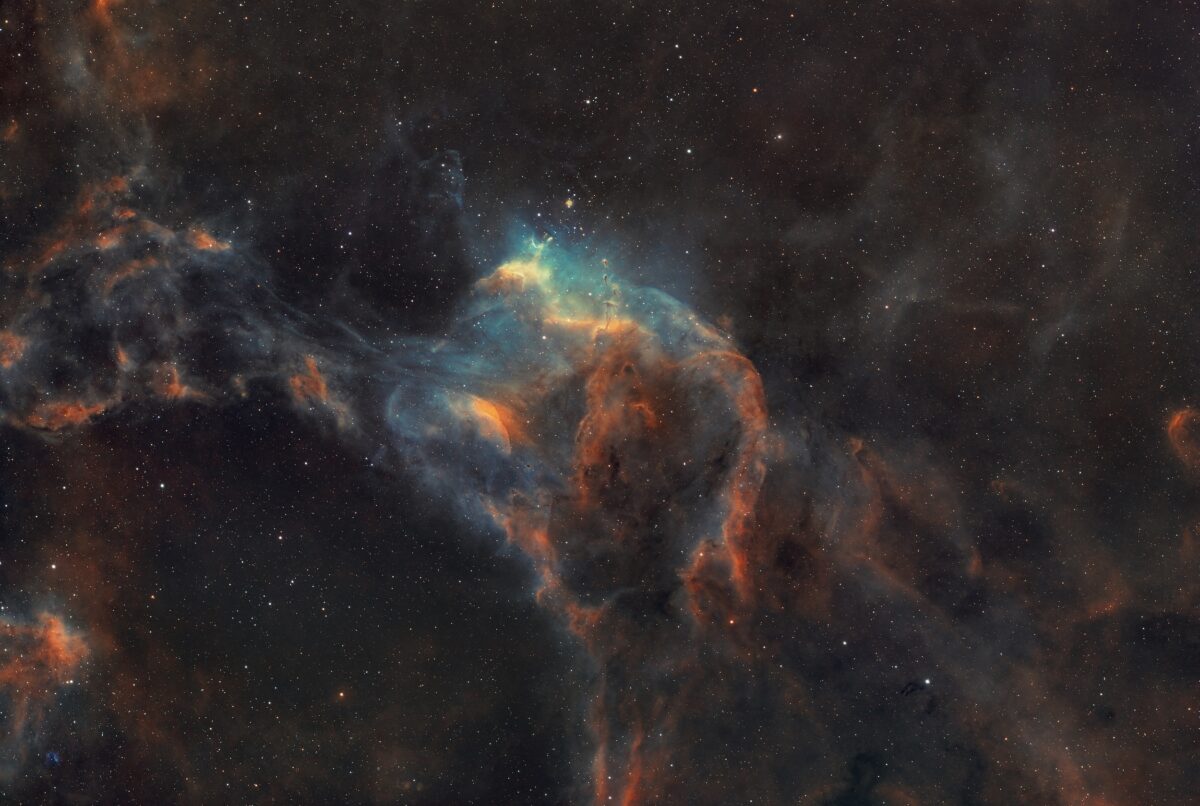
The Southern Tadpole Nebula – Gum 37, named after Australian astronomer Colin Gum – is associated with the star cluster NGC 3572. It is an emission nebula in the southern constellation of Carina, less than 10,000 light-years from Earth. Photo: MPAS member Nik Axaris
Highlights this month
- 6SunThe Moon passes Mars — 2° apart. (5:58am)
- 6SunMercury is stationary — resumes direct (eastward) motion. (4:14pm)
- 10ThuMercury and Saturn in conjunction — 2° apart. (11:09pm)
- 11FriVenus is stationary — resumes direct (eastward) motion. (12:29am)
- 22TueMercury at greatest morning elongation (27° from the Sun, mag 0.4) — best morning apparition. (4:50am)
- 23WedLyrids meteor shower peaks (up to 18/hr). A 27% Moon washes out fainter meteors for part of the night.
- 25FriThe Moon passes Saturn — 2° apart. (12:31pm)
- 25FriThe Moon passes Venus — 2° apart. (1:18pm)
- 26SatThe Moon passes Mercury — 4° apart. (7:21am)
- 29TueVenus and Saturn in conjunction — 4° apart. (7:54am)
As the skies get dark this month, you will notice that the constellations scattered along the arc of the Milky Way come into view. Crux – also known as the Southern Cross – and Centaurus, with the bright stars Rigil Kentaurus and Hadar – or Alpha Centauri and Beta Centauri – are on show. In the south-east, do not miss the bright star Antares in Scorpius. On the opposite side of the sky you will see Canopus in Carina. There is relatively little going on in the sky overhead, as this area is dominated by the long and winding constellation Hydra. However, you will find the bright star Spica in Virgo high in the east.
The very finest of all globular clusters is the startlingly bright Omega Centauri (NGC 5139). This 13 billion-year-old, one million star-strong globular is thought to be the nucleus of a dwarf galaxy that collided with the Milky Way. It can be found by making an equilateral triangle using The Pointers, Crux and Epsilon Centauri.
By far the most impressive sight is the great arc of the Milky Way galaxy. It stretches all the way from the magnificent region in the east around the constellations Scorpius and Sagittarius, through Crux, Carina and Vela, and down to Puppis and Canis Major. The bright star Acrux, or Alpha Crucis, in Crux is a multiple star that can be resolved by a small telescope. The galaxy M83, also known as the Southern Pinwheel, in Hydra is an excellent large-aperture telescope object.
There are two meteor showers in April: The Lyrids, which reach their peak on the night of April 22-23, when you can expect to see an average of 10 meteors an hour in dark, clear skies; and the Puppid meteor shower, which will be producing its peak rate of meteors around April 24. No special equipment or a lot of skill are required to view a meteor shower; all you really need is a clear sky and lots of patience. For optimum viewing, find a secluded area away from the city lights. Once you have found your viewing spot, make sure you are comfortable, especially if you plan to stay out long – meteor-watching can be a waiting game.
By Nerida Langcake
This article appeared in the April 2025 issue of the Mornington Peninsula Magazine.
The sky in detail — April 2025
Sun & twilight
| Date | Sunrise | Sunset | Day length | Astro. dark begins | ends |
|---|---|---|---|---|---|
| Tue 1 | 7:34am | 7:13pm | 11h 39m | 8:41pm | 6:06am |
| Thu 10 | 6:42am | 6:00pm | 11h 18m | 7:27pm | 5:14am |
| Sun 20 | 6:51am | 5:46pm | 10h 54m | 7:14pm | 5:23am |
| Wed 30 | 7:01am | 5:33pm | 10h 33m | 7:03pm | 5:31am |
Days shorten by about 67 minutes over the month.
The Moon
- First QuarterSat 5, 1:12pm
- Full MoonSun 13, 10:27am
- Last QuarterMon 21, 11:44am
- New MoonMon 28, 5:30am
Apogee 14 Apr (406,200 km) · Perigee 27 Apr (356,700 km)
The planets
Rise/set for mid-month at The Briars.
| Planet | In | Mag | Rise | Transit | Set | Best |
|---|---|---|---|---|---|---|
| Mercury | Psc | 0.6 | 4:38am | 10:46am | 4:54pm | Morning |
| Venus | Psc | −4.5 | 4:24am | 10:20am | 4:17pm | Morning |
| Mars | Cnc | 0.7 | 2:05pm | 6:51pm | 11:37pm | Evening |
| Jupiter | Tau | −1.8 | 11:09am | 3:55pm | 8:41pm | Evening |
| Saturn | Psc | 1.1 | 4:22am | 10:35am | 4:47pm | Morning |
| Uranus | Tau | 5.8 | 9:19am | 2:18pm | 7:18pm | Hidden |
| Neptune | Psc | 7.9 | 4:45am | 10:50am | 4:55pm | Morning |
Meteor showers
- Lyrids — peaks 23 April, radiant in Lyra (up to 18/hr). A modest shower; the radiant is low in the north-east before dawn from Victoria. A 27% Moon washes out fainter meteors for part of the night.
Computed for The Briars, Mt Martha. Times are local (Melbourne).
Generated automatically from the MPAS sky engine on 14 August 2026.
The solar system — April 2025
Evening sky Morning sky Up much of the night Lost in the Sun’s glare
Open the full interactive orrery ↗ — fast-forward, pick any date, toggle the Moon and more.
Looking for an earlier month? Browse all past monthly guides →