
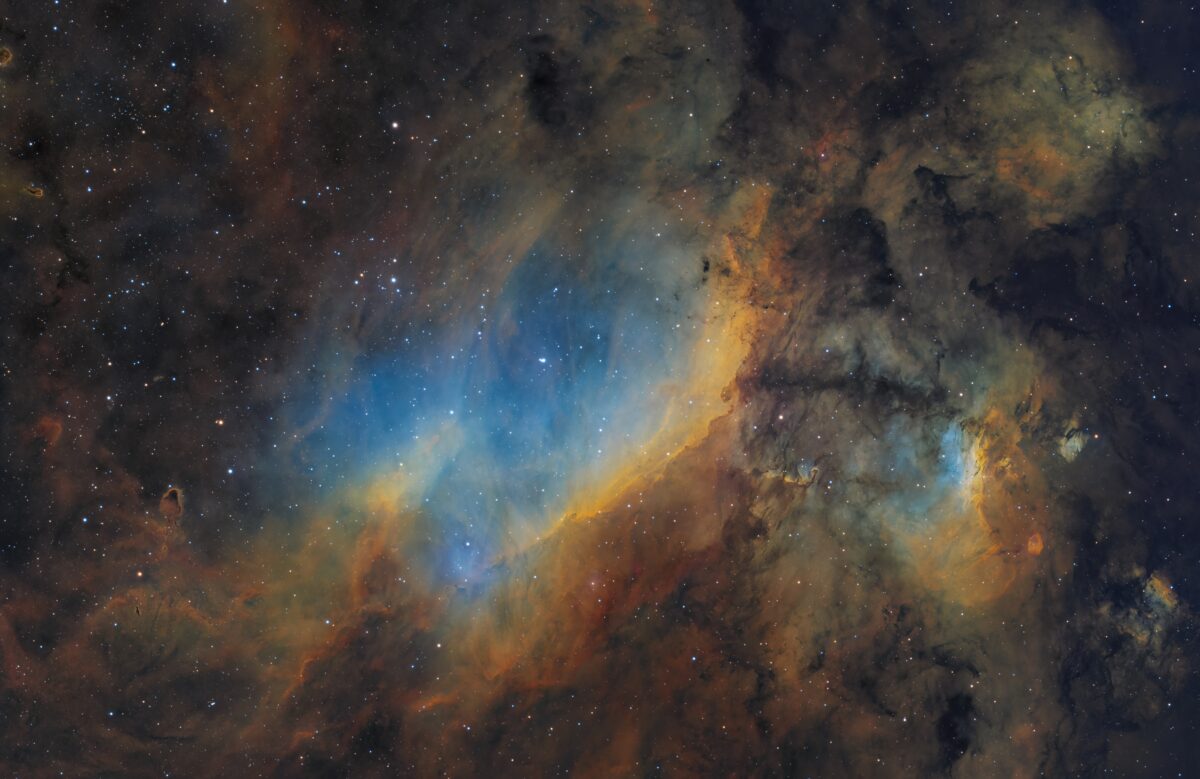
The Prawn Nebula, also known as IC 4628, is an emission nebula in the Sagittarius Arm of the Milky Way. It stretches 250 light-years and is about 6000 light-years from Earth in the constellation Scorpius. Photo: MPAS member Nik Axaris
Highlights this month
- 6MonThe Moon passes Saturn — 3° apart. (11:00am)
- 14TueThe Moon passes Jupiter — 4° apart. (11:11am)
- 21TueOrionids meteor shower peaks (up to 20/hr). A thin 0% Moon leaves the sky dark.
- 24FriThe Moon passes Mercury — 2° apart. (1:50am)
- 30ThuMercury at greatest evening elongation (24° from the Sun, mag −0.2) — best evening apparition. (8:47am)
After the wonderfully rich views of the southern winter, October night skies look rather empty – with the exception of the bright planets Venus, Jupiter and Saturn. However, this does not mean there is nothing else to see.
Two of the celestial showpieces of the southern skies are on show this month: the Large and Small Magellanic Clouds. These galaxies lie relatively close to the Milky Way. The irregular galaxy known as the Small Magellanic Cloud sits in the constellation Tucana and can be seen with the unaided eye. It stretches roughly seven times the moon’s apparent diameter across the sky. The Large Magellanic Cloud is also visible to the naked eye and is a magnificent sight on the Dorado-Mensa border. Binoculars or small telescopes reveal many star clusters and patches of nebulosity within the LMC.
This month’s conjunctions, which is when two astronomical objects appear close to each other in the sky, include the moon and Saturn on October 6, the moon and Jupiter on October 14, the moon and Venus on October 20, Mercury and Mars on October 21, the moon and Mars on October 23, and the moon and Mercury on October 24.
Also occurring is the annual Orionid meteor shower. Orionids are active every year in October, this year peaking on the night of October 21-22 when potentially up to 20 meteors will be visible every hour. Orionids are named after Orion, because the meteors seem to emerge or radiate from the same area of the sky as the constellation. No special equipment or a lot of skill is required to view a meteor shower; all you really need is a clear sky and lots of patience. For optimum viewing, find a secluded spot away from the city lights. Once you have found your viewing spot, make sure you are comfortable, especially if you plan to stay out long – meteor watching can be a waiting game.
By Nerida Langcake
This article appeared in the October 2025 issue of the Mornington Peninsula Magazine.
The sky in detail — October 2025
Sun & twilight
| Date | Sunrise | Sunset | Day length | Astro. dark begins | ends |
|---|---|---|---|---|---|
| Wed 1 | 5:55am | 6:24pm | 12h 29m | 7:54pm | 4:26am |
| Fri 10 | 6:42am | 7:33pm | 12h 51m | 9:04pm | 5:10am |
| Mon 20 | 6:27am | 7:43pm | 13h 15m | 9:17pm | 4:53am |
| Fri 31 | 6:13am | 7:54pm | 13h 41m | 9:33pm | 4:35am |
Days lengthen by about 72 minutes over the month.
The Moon
- Full MoonTue 7, 2:52pm
- Last QuarterTue 14, 5:09am
- New MoonTue 21, 11:29pm
- First QuarterThu 30, 3:23am
Perigee 9 Oct (359,600 km) · Apogee 24 Oct (406,100 km)
The planets
Rise/set for mid-month at The Briars.
| Planet | In | Mag | Rise | Transit | Set | Best |
|---|---|---|---|---|---|---|
| Mercury | Lib | −0.3 | 7:22am | 2:21pm | 9:22pm | Hidden |
| Venus | Vir | −3.7 | 5:52am | 11:52am | 5:53pm | Hidden |
| Mars | Lib | 1.5 | 7:39am | 2:36pm | 9:34pm | Evening |
| Jupiter | Gem | −2.0 | 2:38am | 7:29am | 12:19pm | Morning |
| Saturn | Psc | 0.7 | 5:21pm | 11:35pm | 5:52am | Evening |
| Uranus | Tau | 5.7 | 10:42pm | 3:41am | 8:36am | Morning |
| Neptune | Psc | 7.8 | 5:40pm | 11:45pm | 5:55am | Evening |
Meteor showers
- Orionids — peaks 21 October, radiant in Orion (up to 20/hr). Also from Halley's Comet; Orion rides high after midnight from the south, giving a fair show. A thin 0% Moon leaves the sky dark.
Computed for The Briars, Mt Martha. Times are local (Melbourne).
Generated automatically from the MPAS sky engine on 14 August 2026.
The solar system — October 2025
Evening sky Morning sky Up much of the night Lost in the Sun’s glare
Open the full interactive orrery ↗ — fast-forward, pick any date, toggle the Moon and more.
Looking for an earlier month? Browse all past monthly guides →