
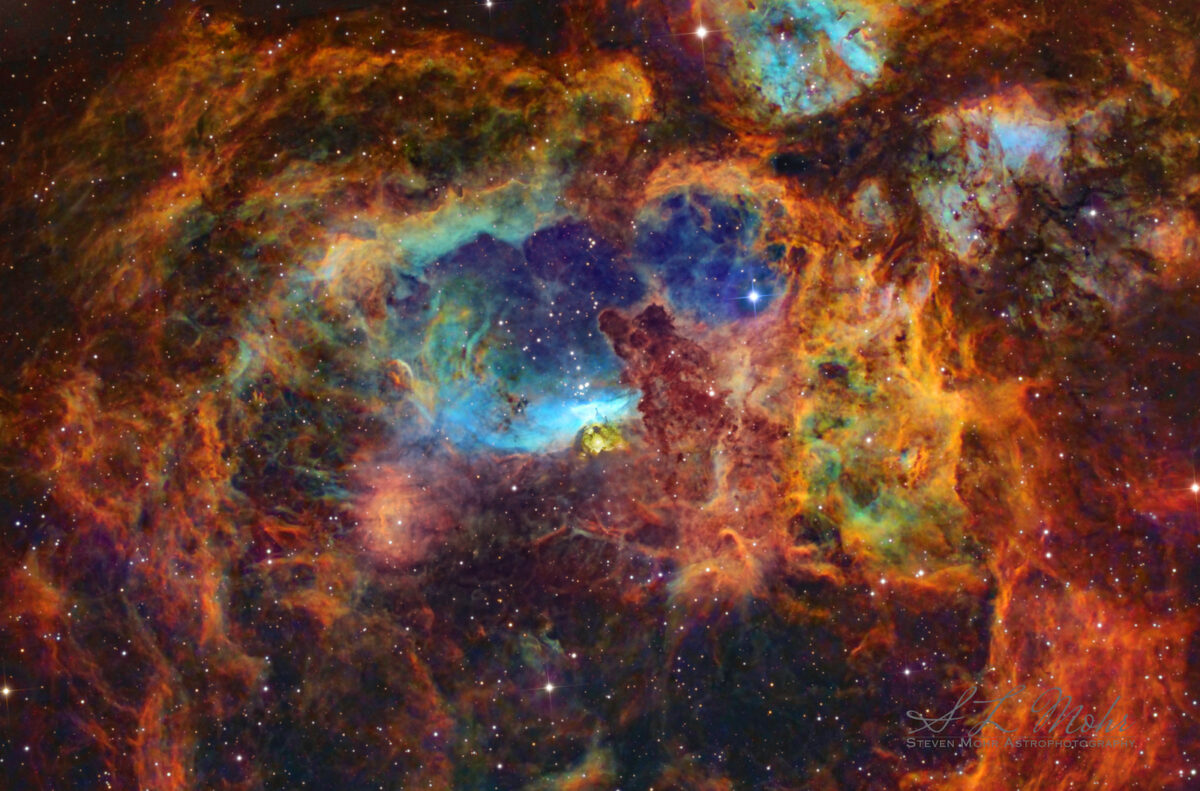
This region of space is catalogued as NGC6357, and has some interesting common names like the Lobster Nebula or the War and Peace Nebula. NGC 6357 spans about 400 light years across and lies about 8,000 light years away towards the constellation of the Scorpion. Image taken by MPAS Member Steven Mohr.
Highlights this month
- 1SunMercury in superior conjunction with the Sun — lost in the glare. (11:58pm)
- 2MonSaturn at opposition — closest and brightest of the year, up all night in Capricornus (mag 0.1). (3:44pm)
- 11WedThe Moon passes Venus — 4° apart. (7:53pm)
- 13FriPerseids meteor shower peaks (up to 100/hr). A thin 24% Moon leaves the sky dark.
- 20FriJupiter at opposition — closest and brightest of the year, up all night in Capricornus (mag −2.7). (10:23am)
- 20FriUranus is stationary — begins retrograde (westward) motion. (10:45am)
- 21SatThe Moon passes Saturn — 4° apart. (5:43am)
- 22SunThe Moon passes Jupiter — 4° apart. (6:19pm)
In the August skies you can find Sagittarius, the Archer, lying almost overhead; to its southwest lies Scorpius, the Scorpion. When you look towards these constellations on a clear night, you are looking in the direction of the very heart of our galaxy, the Milky Way.
With the rich regions of Sagittarius and Scutum visible high in the sky, you can pick up a pair of binoculars and ‘wander’ along the Milky Way from Scutum to Centaurus. The constellation Scutum, the Shield, is relatively small – the fifth-smallest of 88 constellations. It is located between the stars of Aquila and Sagittarius, quite close to the constellation Serpens Cauda, the Snake’s Tail, in a wonderfully rich and interesting part of the Milky Way.
In Sagittarius is M8, the Lagoon Nebula, which is visually about three times the size of the full moon and is the largest and brightest of a number of nebulosities in and around Sagittarius. It is an excellent target for a small telescope. And M17, the Omega Nebula, is also a good target for a small telescope. It is a glowing cloud of hydrogen gas that resembles the Greek capital letter Omega. The open cluster M23 and the Sagittarius Star Cloud M24 are ideal binocular objects. A large telescope is needed to clearly see M20, the Trifid Nebula.
On August 2, Saturn will be at opposition, which is when the planet is closest to Earth and brightest for the year. On August 10, the red planet Mars will be near the crescent moon, followed by Venus close to the crescent moon the next night. August 19 will then see Jupiter at opposition. Saturn will be near the moon on August 20, followed by Jupiter near the moon on August 22.
As part of National Science Week 2021, MPAS and The Briars Historic Park will present a public talk all about meteors and meteorites on August 20 at the Mount Martha Observatory. See our special event page for more information and tickets.
By Nerida Langcake
This article appeared in the August 2021 issue of the Mornington Peninsula Magazine.
The sky in detail — August 2021
Sun & twilight
| Date | Sunrise | Sunset | Day length | Astro. dark begins | ends |
|---|---|---|---|---|---|
| Sun 1 | 7:21am | 5:32pm | 10h 11m | 7:03pm | 5:50am |
| Tue 10 | 7:12am | 5:39pm | 10h 28m | 7:09pm | 5:42am |
| Fri 20 | 6:59am | 5:48pm | 10h 49m | 7:17pm | 5:31am |
| Tue 31 | 6:44am | 5:57pm | 11h 14m | 7:25pm | 5:16am |
Days lengthen by about 63 minutes over the month.
The Moon
- New MoonSun 8, 11:57pm
- First QuarterMon 16, 1:21am
- Full MoonSun 22, 9:58pm
- Last QuarterMon 30, 5:16pm
Apogee 2 Aug (405,000 km) · Perigee 17 Aug (369,400 km) · Apogee 30 Aug (404,700 km)
The planets
Rise/set for mid-month at The Briars.
| Planet | In | Mag | Rise | Transit | Set | Best |
|---|---|---|---|---|---|---|
| Mercury | Leo | −0.8 | 7:48am | 1:18pm | 6:48pm | Hidden |
| Venus | Vir | −3.8 | 8:43am | 2:42pm | 8:41pm | Evening |
| Mars | Leo | 1.8 | 7:59am | 1:34pm | 7:09pm | Hidden |
| Jupiter | Aqr | −2.7 | 6:00pm | 12:49am | 7:34am | All night |
| Saturn | Cap | 0.1 | 4:27pm | 11:31pm | 6:39am | All night |
| Uranus | Ari | 5.8 | 12:26am | 5:36am | 10:46am | Morning |
| Neptune | Psc | 7.8 | 8:03pm | 2:21am | 8:36am | Morning |
Meteor showers
- Perseids — peaks 13 August, radiant in Perseus (up to 100/hr). The famous northern shower, but its far-northern radiant scarcely rises from Victoria — only a trickle this far south. A thin 24% Moon leaves the sky dark.
Computed for The Briars, Mt Martha. Times are local (Melbourne).
Generated automatically from the MPAS sky engine on 20 September 2026.
The solar system — August 2021
Evening sky Morning sky Up much of the night Lost in the Sun’s glare
Open the full interactive orrery ↗ — fast-forward, pick any date, toggle the Moon and more.
Looking for an earlier month? Browse all past monthly guides →