
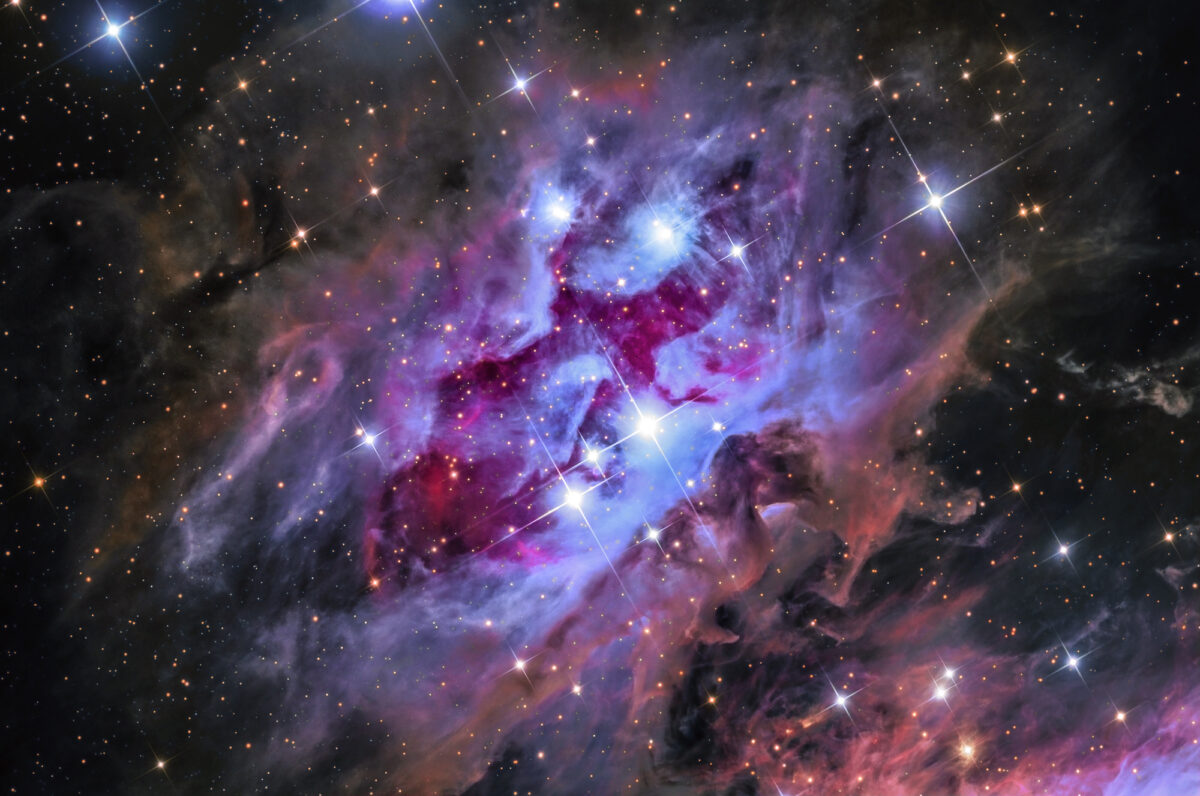
NGC 1977 is commonly called the Running Man Nebula due to the somewhat identifiable outline of a man striding through the sky. The Running Man lies south of the famous and substantial stellar nursery called the Orion Nebula, being some 1500 light-years away in the constellation of Orion. Photo by MPAS member Steven Mohr
Highlights this month
- 5FriUranus at opposition — closest and brightest of the year, up all night in Aries (mag 5.7). (11:13am)
- 5FriSouthern Taurids meteor shower peaks (up to 5/hr). A thin 0% Moon leaves the sky dark.
- 8MonThe Moon passes Venus — 2° apart. (8:36pm)
- 11ThuThe Moon passes Saturn — 4° apart. (1:14am)
- 12FriThe Moon passes Jupiter — 5° apart. (2:01am)
- 17WedLeonids meteor shower peaks (up to 15/hr). A bright 96% Moon interferes badly this year.
- 29MonMercury in superior conjunction with the Sun — lost in the glare. (3:28pm)
This month, the constellations Eridanus and Cetus sit right above you. Eridanus, the River, is naturally long and winding and its end is marked by the bright star Achernar, which can be seen high in the sky almost due south. Canis Major can be located in the east with the blazing star Sirius making it easy to find. Orion and Taurus are also coming into view in the east. It is easy to identify Orion through its brightest stars: blue-white Rigel (Beta Orionis) and red Betelgeuse (Alpha Orionis).
As Cetus is high in the sky, a large telescope will show you the interesting spiral galaxy M77, sitting very close to the star Delta Ceti. The beautiful Magellanic Clouds should be your next target. The Large Magellanic Cloud sits across the border between the constellations Dorado, the Goldfish (or Swordfish), and Mensa, the Table Mountain. A small telescope is all you need to explore the sparkling star clusters as well as the Tarantula Nebula (NGC 2070), nestled within the LMC. Meanwhile, a short distance away in the constellation Tucana, you can see the Small Magellanic Cloud and the globular cluster 47 Tucanae (NGC 104). These are wonderful binocular or small telescope targets. Looking towards the northeast, the Hyades and Pleiades open star clusters make excellent binocular targets.
The Leonid meteor shower is annually active in November, and this year the Leonids will peak late on the night of November 16 until dawn the next day. The bright waxing gibbous moon will be out nearly all night long and will set in the hours before sunrise. The shower is called Leonids because its radiant – or the point in the sky from which the meteors seem to emerge – lies in the constellation Leo. The Leonids occur when the Earth passes through the debris left by Comet Tempel-Tuttle. The comet takes about 33 years to make one orbit of the Sun.
By Nerida Langcake
This article appeared in the November 2021 issue of the Mornington Peninsula Magazine.
The sky in detail — November 2021
Sun & twilight
| Date | Sunrise | Sunset | Day length | Astro. dark begins | ends |
|---|---|---|---|---|---|
| Mon 1 | 6:12am | 7:55pm | 13h 43m | 9:34pm | 4:34am |
| Wed 10 | 6:03am | 8:05pm | 14h 02m | 9:48pm | 4:20am |
| Sat 20 | 5:55am | 8:16pm | 14h 21m | 10:04pm | 4:08am |
| Tue 30 | 5:51am | 8:26pm | 14h 36m | 10:19pm | 3:59am |
Days lengthen by about 53 minutes over the month.
The Moon
- New MoonFri 5, 8:21am
- First QuarterThu 11, 11:40pm
- Full MoonFri 19, 8:02pm
- Last QuarterSat 27, 11:36pm
Perigee 6 Nov (358,500 km) · Apogee 21 Nov (406,200 km)
The planets
Rise/set for mid-month at The Briars.
| Planet | In | Mag | Rise | Transit | Set | Best |
|---|---|---|---|---|---|---|
| Mercury | Lib | −1.0 | 5:39am | 12:33pm | 7:27pm | Hidden |
| Venus | Sgr | −4.6 | 8:44am | 4:21pm | 11:59pm | Evening |
| Mars | Lib | 1.7 | 5:25am | 12:15pm | 7:05pm | Hidden |
| Jupiter | Cap | −2.1 | 12:37pm | 7:27pm | 2:20am | Evening |
| Saturn | Cap | 0.5 | 11:18am | 6:24pm | 1:33am | Evening |
| Uranus | Ari | 5.7 | 7:08pm | 12:25am | 5:38am | All night |
| Neptune | Aqr | 7.8 | 2:51pm | 9:08pm | 3:29am | Evening |
Meteor showers
- Southern Taurids — peaks 5 November, radiant in Taurus (up to 5/hr). Sparse but rich in slow fireballs over a long, broad maximum. A thin 0% Moon leaves the sky dark.
- Leonids — peaks 17 November, radiant in Leo (up to 15/hr). Fast meteors; the radiant rises after midnight and is moderate from the south. A bright 96% Moon interferes badly this year.
Computed for The Briars, Mt Martha. Times are local (Melbourne).
Generated automatically from the MPAS sky engine on 21 September 2026.
The solar system — November 2021
Evening sky Morning sky Up much of the night Lost in the Sun’s glare
Open the full interactive orrery ↗ — fast-forward, pick any date, toggle the Moon and more.
Looking for an earlier month? Browse all past monthly guides →