
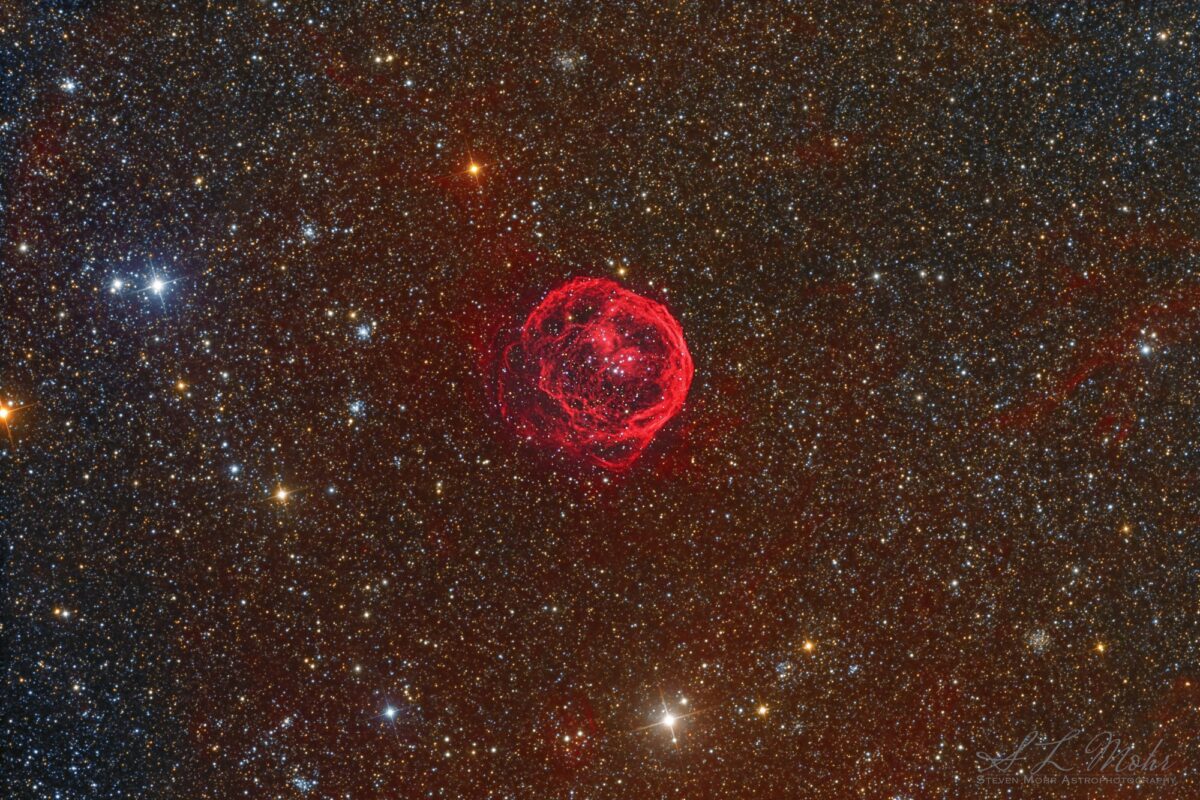
The Henize 70 Super Bubble is about 170,000 light-years from Earth in the constellation Seabream, within the Large Magellanic Cloud. About 300 light-years in diameter, it is a luminous super bubble of interstellar gas blown by wind from hot, massive stars and supernova explosions, its interior filled with tenuous hot and expanding gas.
Photo: MPAS member Steven Mohr
Highlights this month
- 2WedThe Moon passes Saturn — 4° apart. (10:25am)
- 5SatThe Moon passes Jupiter — 2° apart. (9:25am)
- 5SatSouthern Taurids meteor shower peaks (up to 5/hr). A bright 89% Moon interferes badly this year.
- 9WedMercury in superior conjunction with the Sun — lost in the glare. (3:27am)
- 9WedUranus at opposition — closest and brightest of the year, up all night in Aries (mag 5.7). (7:41pm)
- 12SatThe Moon passes Mars — 2° apart. (12:19am)
- 17ThuLeonids meteor shower peaks (up to 15/hr). A 43% Moon washes out fainter meteors for part of the night.
- 24ThuJupiter is stationary — resumes direct (eastward) motion. (11:26pm)
- 29TueThe Moon passes Saturn — 4° apart. (5:56pm)
The constellations Scorpius and Sagittarius are slowly leaving our night skies to be replaced by Orion and its nebulae, and the bright star Sirius. Looking towards the celestial pole you can find the constellations Reticulum, the Net; Hydrus, the Little Water Snake; Tucana, the Toucan; and Octans, the Octant, while the Southern Cross (Crux) grazes the southern horizon before rising again in summer.
Conjunctions are when two astronomical objects appear close to each other in the sky, and this month there are several between the moon and various planets, including November 2 with Saturn, November 5 with Jupiter, November 12 with Mars, and again with Saturn on November 29.
The Leonid meteor shower is active each November, and this year the Leonids will peak late on the night November 17 until early next morning. The shower is called Leonids because its radiant, or the point in the sky from which the meteors seem to emerge, lies in the constellation Leo. The Leonids occur when the Earth passes through the debris left by Comet Tempel-Tuttle, which takes about 33 years to orbit the sun.
On November 8 we will witness the only total lunar eclipse of the year. The moon will start passing into the Earth’s shadow from 7pm when it is still below the horizon as seen from Melbourne. The partial eclipse begins at 8.09pm, and the moon will be fully within the Earth’s shadow from 9.16pm until 10.41pm. The eclipse ends at 12.49am on November 9 when the moon leaves Earth’s shadow again. For a great viewing opportunity, visit the Mornington Peninsula Astronomical Society at the Mount Martha Observatory, where the evening will start with a short presentation about why eclipses happen and when we can expect the next ones. Then head outside to observe the event through our telescopes and get tips on what to look for or how to take photos of the eclipse. Bookings are required and can be completed on our website.
By Nerida Langcake
This article appeared in the November 2022 issue of the Mornington Peninsula Magazine.
The sky in detail — November 2022
Sun & twilight
| Date | Sunrise | Sunset | Day length | Astro. dark begins | ends |
|---|---|---|---|---|---|
| Tue 1 | 6:13am | 7:55pm | 13h 42m | 9:34pm | 4:34am |
| Thu 10 | 6:03am | 8:05pm | 14h 01m | 9:48pm | 4:21am |
| Sun 20 | 5:55am | 8:16pm | 14h 20m | 10:03pm | 4:08am |
| Wed 30 | 5:51am | 8:26pm | 14h 35m | 10:18pm | 3:59am |
Days lengthen by about 53 minutes over the month.
The Moon
- First QuarterTue 1, 5:34pm
- Full MoonTue 8, 10:07pm
- Last QuarterThu 17, 12:29am
- New MoonThu 24, 10:00am
Apogee 14 Nov (405,200 km) · Perigee 26 Nov (362,600 km)
The planets
Rise/set for mid-month at The Briars.
| Planet | In | Mag | Rise | Transit | Set | Best |
|---|---|---|---|---|---|---|
| Mercury | Lib | −1.0 | 6:09am | 1:19pm | 8:30pm | Hidden |
| Venus | Lib | −3.8 | 6:20am | 1:29pm | 8:38pm | Hidden |
| Mars | Tau | −1.5 | 10:35pm | 3:18am | 7:57am | Morning |
| Jupiter | Psc | −2.5 | 3:33pm | 9:40pm | 3:52am | Evening |
| Saturn | Cap | 0.6 | 12:14pm | 7:10pm | 2:09am | Evening |
| Uranus | Ari | 5.7 | 7:30pm | 12:43am | 5:51am | All night |
| Neptune | Psc | 7.8 | 3:03pm | 9:17pm | 3:36am | Evening |
Meteor showers
- Southern Taurids — peaks 5 November, radiant in Taurus (up to 5/hr). Sparse but rich in slow fireballs over a long, broad maximum. A bright 89% Moon interferes badly this year.
- Leonids — peaks 17 November, radiant in Leo (up to 15/hr). Fast meteors; the radiant rises after midnight and is moderate from the south. A 43% Moon washes out fainter meteors for part of the night.
Computed for The Briars, Mt Martha. Times are local (Melbourne).
Generated automatically from the MPAS sky engine on 17 August 2026.
The solar system — November 2022
Evening sky Morning sky Up much of the night Lost in the Sun’s glare
Open the full interactive orrery ↗ — fast-forward, pick any date, toggle the Moon and more.
Looking for an earlier month? Browse all past monthly guides →