
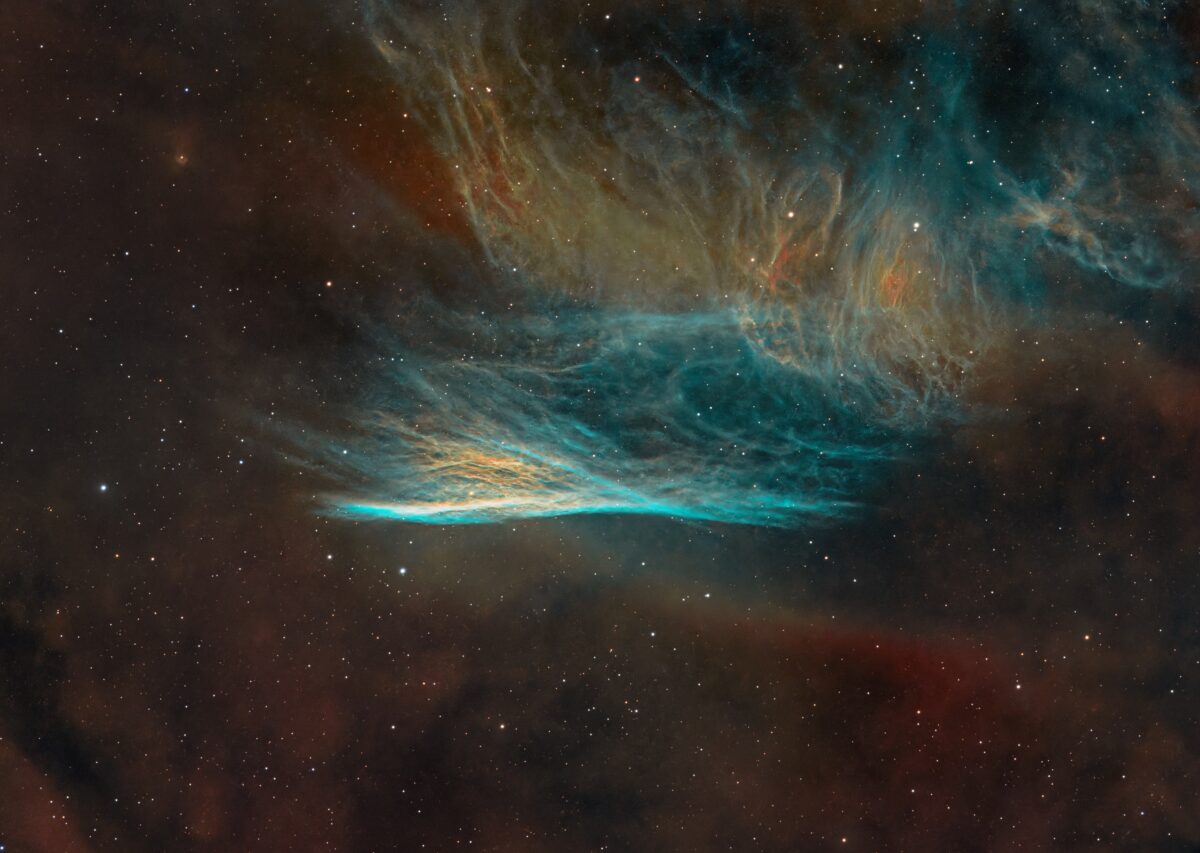
Officially known as NGC 2736, the Pencil Nebula is part of the huge Vela supernova remnant in the southern constellation Vela, about 815 light-years from our solar system and from whose shock wave it is thought to have formed. The nebula is moving at roughly 644,000km/h. Photo: MPAS member Nik Axaris
Highlights this month
- 8SatMercury at greatest evening elongation (18° from the Sun, mag −0.4) — best evening apparition. (5:00pm)
- 9SunThe Moon passes Mars — 2° apart. (12:00pm)
- 12WedSaturn in superior conjunction with the Sun — lost in the glare. (9:03pm)
- 15SatMercury is stationary — begins retrograde (westward) motion. (7:43am)
- 20ThuNeptune in superior conjunction with the Sun — lost in the glare. (10:12am)
- 20ThuAutumn equinox.
- 23SunVenus in inferior conjunction with the Sun — lost in the glare. (12:22pm)
- 25TueMercury in inferior conjunction with the Sun — lost in the glare. (6:46am)
Observing the night sky from southern latitudes this month with a good pair of binoculars will give you plenty to see, including the open cluster known as the Southern Pleiades (IC 2602). Its brightest member, the star Theta Carinae, can be seen with the naked eye. If you turn binoculars on the cluster, you can see about 24 other sparkling stars. Just north of the Southern Pleiades is the glowing region NGC 3372, visible to the naked eye. Also known as the Carina Nebula, it is beautiful when observed through a small telescope.
Looking south is the False Cross, which is formed by four stars in the constellations Carina and Vela. The False Cross asterism resembles the constellation Crux, the Southern Cross, but is somewhat larger. Still looking south you’ll find the globular cluster Omega Centauri (NGC 5139), the largest globular cluster in the Milky Way and a must-see object. A large telescope shows many of its stars, while binoculars show the cluster as a bright patch of light. In the west, the Jewel Box open cluster (NGC 4755), in Crux, is a nice target for small telescopes and binoculars.
Meanwhile Spica, the brightest star in Virgo, twinkles away in the east, with the blazing Canopus in Carina taking centre stage in the south-west sky. The constellation Orion is gradually sinking out of view, so make the most of it before it disappears.
This month’s conjunctions, which is when two astronomical objects appear close to each other in the sky, include the moon and Mercury on March 1, the moon and Venus on March 2, Mercury and Neptune on March 3, the moon and Jupiter on March 6, the moon and Mars, and Venus and Mercury, on March 9, and the moon and Saturn on March 28. On March 24 is the Saturn ring plane crossing, which occurs when Earth or the sun pass through the plane of Saturn’s rings. This happens every 13 to 15 years and allows us to see the rings edge-on.
By Nerida Langcake
This article appeared in the March 2025 issue of the Mornington Peninsula Magazine.
The sky in detail — March 2025
Sun & twilight
| Date | Sunrise | Sunset | Day length | Astro. dark begins | ends |
|---|---|---|---|---|---|
| Sat 1 | 7:04am | 8:00pm | 12h 56m | 9:32pm | 5:31am |
| Mon 10 | 7:13am | 7:47pm | 12h 34m | 9:17pm | 5:43am |
| Thu 20 | 7:23am | 7:32pm | 12h 09m | 9:00pm | 5:54am |
| Mon 31 | 7:33am | 7:15pm | 11h 42m | 8:42pm | 6:05am |
Days shorten by about 75 minutes over the month.
The Moon
- First QuarterFri 7, 3:29am
- Full MoonFri 14, 5:58pm
- Last QuarterSat 22, 10:36pm
- New MoonSat 29, 9:58pm
Perigee 2 Mar (362,000 km) · Apogee 18 Mar (405,900 km) · Perigee 30 Mar (358,000 km)
The planets
Rise/set for mid-month at The Briars.
| Planet | In | Mag | Rise | Transit | Set | Best |
|---|---|---|---|---|---|---|
| Mercury | Psc | 1.2 | 8:37am | 2:18pm | 7:59pm | Hidden |
| Venus | Psc | −4.0 | 8:34am | 2:01pm | 7:29pm | Hidden |
| Mars | Gem | 0.1 | 4:36pm | 9:12pm | 1:50am | Evening |
| Jupiter | Tau | −2.0 | 1:49pm | 6:37pm | 11:25pm | Evening |
| Saturn | Psc | 1.0 | 7:06am | 1:23pm | 7:40pm | Hidden |
| Uranus | Tau | 5.8 | 12:14pm | 5:14pm | 10:15pm | Evening |
| Neptune | Psc | 7.9 | 7:42am | 1:48pm | 7:54pm | Hidden |
Computed for The Briars, Mt Martha. Times are local (Melbourne).
Generated automatically from the MPAS sky engine on 14 August 2026.
The solar system — March 2025
Evening sky Morning sky Up much of the night Lost in the Sun’s glare
Open the full interactive orrery ↗ — fast-forward, pick any date, toggle the Moon and more.
Looking for an earlier month? Browse all past monthly guides →