
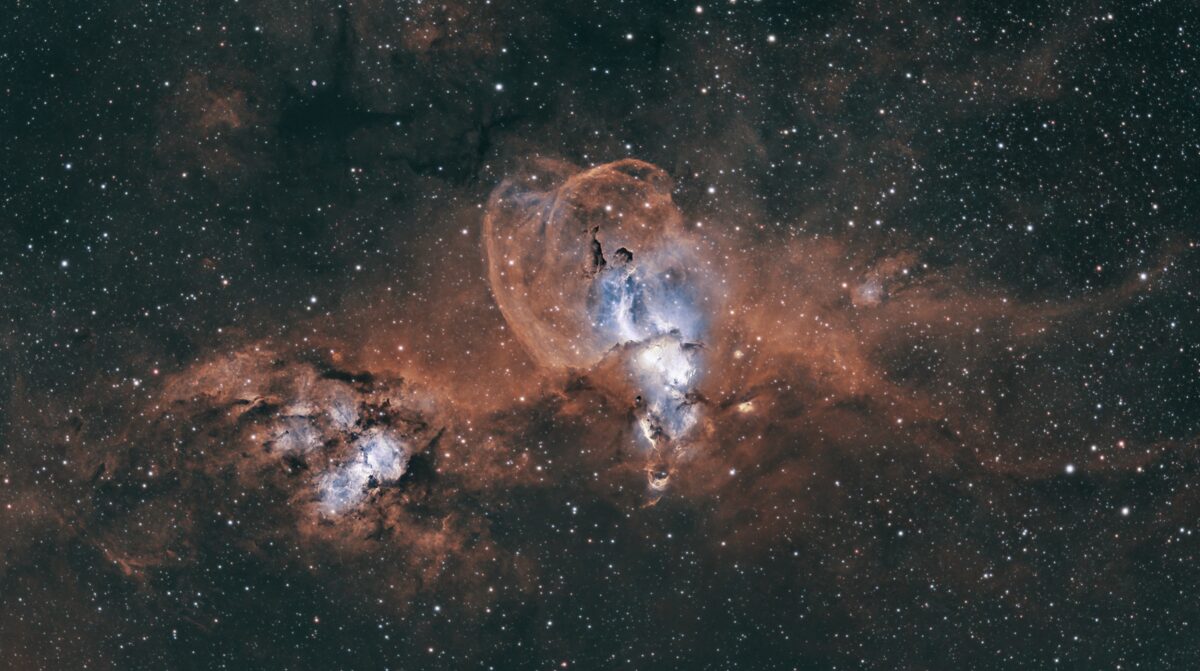
The Statue of Liberty Nebula, NGC 3576, is a large, bright emission nebula about 9800 light-years away in the constellation Carina. To the left is another nebula, NGC 3603, and although both appear close in the image, NGC 3603 is more than twice the distance away. Photo: MPAS member Guido Tack
Highlights this month
- 4SunThe Moon passes Mars — 2° apart. (10:27am)
- 6TueEta Aquariids meteor shower peaks (up to 50/hr). A bright 67% Moon interferes badly this year.
- 18SunUranus in superior conjunction with the Sun — lost in the glare. (9:52am)
- 23FriThe Moon passes Saturn — 2° apart. (1:43am)
- 24SatThe Moon passes Venus — 4° apart. (6:37am)
- 30FriMercury in superior conjunction with the Sun — lost in the glare. (2:02pm)
The Milky Way rises high in the south this month, with Sagittarius and Scorpius sitting in the east – a clue that winter is on its way in the southern hemisphere. Sitting high in the southern sky during May is the prominent constellation Crux, the Southern Cross. If you have a small telescope, be sure to point it at Crux’s brightest star Acrux, which is actually a double star made of two blue-white stars.
The large constellation Centaurus, the Centaur, sits within the stunning star fields of the Milky Way and is home to arguably the finest globular cluster in the whole night sky: the magnificent Omega Centauri, or NGC 5139. Looking south to Carina, there are several fine open clusters on view. NGC 3532, the Pincushion Cluster, can be seen with the naked eye, but binoculars reveal its many twinkling stars well. The magnitude 4.2 cluster NGC 3114 is an interesting target for a small telescope, while NGC 2516, the Southern Beehive, contains approximately 100 stars and can be viewed with just a pair of binoculars.
The annual Eta Aquariid meteor shower, which is caused by the dust left over from Halley’s Comet entering our atmosphere and vaporising, peaks around May 6-7. If you are very lucky you can expect to see roughly 30 to 50 meteors an hour, and the further south you are, the better view of the shower you will get. The meteors appear to be coming from a point near the star Eta Aquarii in Aquarius, and tend to be quite fast-moving.
This month’s conjunctions, which is when two astronomical objects appear close to each other in the sky, include the moon and Jupiter on May 1; the moon and Mars, and also Venus and Neptune, on May 4; the moon and Saturn on May 23; the moon and Venus on May 24; and the moon and Jupiter again on May 28.
By Nerida Langcake
This article appeared in the May 2025 issue of the Mornington Peninsula Magazine.
The sky in detail — May 2025
Sun & twilight
| Date | Sunrise | Sunset | Day length | Astro. dark begins | ends |
|---|---|---|---|---|---|
| Thu 1 | 7:01am | 5:32pm | 10h 31m | 7:02pm | 5:32am |
| Sat 10 | 7:10am | 5:23pm | 10h 13m | 6:53pm | 5:39am |
| Tue 20 | 7:18am | 5:14pm | 9h 56m | 6:46pm | 5:46am |
| Sat 31 | 7:27am | 5:08pm | 9h 42m | 6:42pm | 5:53am |
Days shorten by about 49 minutes over the month.
The Moon
- First QuarterSun 4, 11:53pm
- Full MoonTue 13, 3:02am
- Last QuarterTue 20, 10:06pm
- New MoonTue 27, 1:01pm
Apogee 11 May (406,200 km) · Perigee 26 May (358,500 km)
The planets
Rise/set for mid-month at The Briars.
| Planet | In | Mag | Rise | Transit | Set | Best |
|---|---|---|---|---|---|---|
| Mercury | Ari | −0.7 | 5:48am | 11:12am | 4:36pm | Hidden |
| Venus | Psc | −4.5 | 3:32am | 9:25am | 3:18pm | Morning |
| Mars | Cnc | 1.1 | 12:48pm | 5:49pm | 10:49pm | Evening |
| Jupiter | Tau | −1.7 | 9:38am | 2:22pm | 7:07pm | Hidden |
| Saturn | Psc | 1.1 | 2:39am | 8:48am | 2:57pm | Morning |
| Uranus | Tau | 5.9 | 7:29am | 12:27pm | 5:25pm | Hidden |
| Neptune | Psc | 7.9 | 2:52am | 8:56am | 2:59pm | Morning |
Meteor showers
- Eta Aquariids — peaks 6 May, radiant in Aquarius (up to 50/hr). Debris of Halley's Comet and one of the best showers of the year from the south — swift meteors in the pre-dawn eastern sky. A bright 67% Moon interferes badly this year.
Computed for The Briars, Mt Martha. Times are local (Melbourne).
Generated automatically from the MPAS sky engine on 14 August 2026.
The solar system — May 2025
Evening sky Morning sky Up much of the night Lost in the Sun’s glare
Open the full interactive orrery ↗ — fast-forward, pick any date, toggle the Moon and more.
Looking for an earlier month? Browse all past monthly guides →