
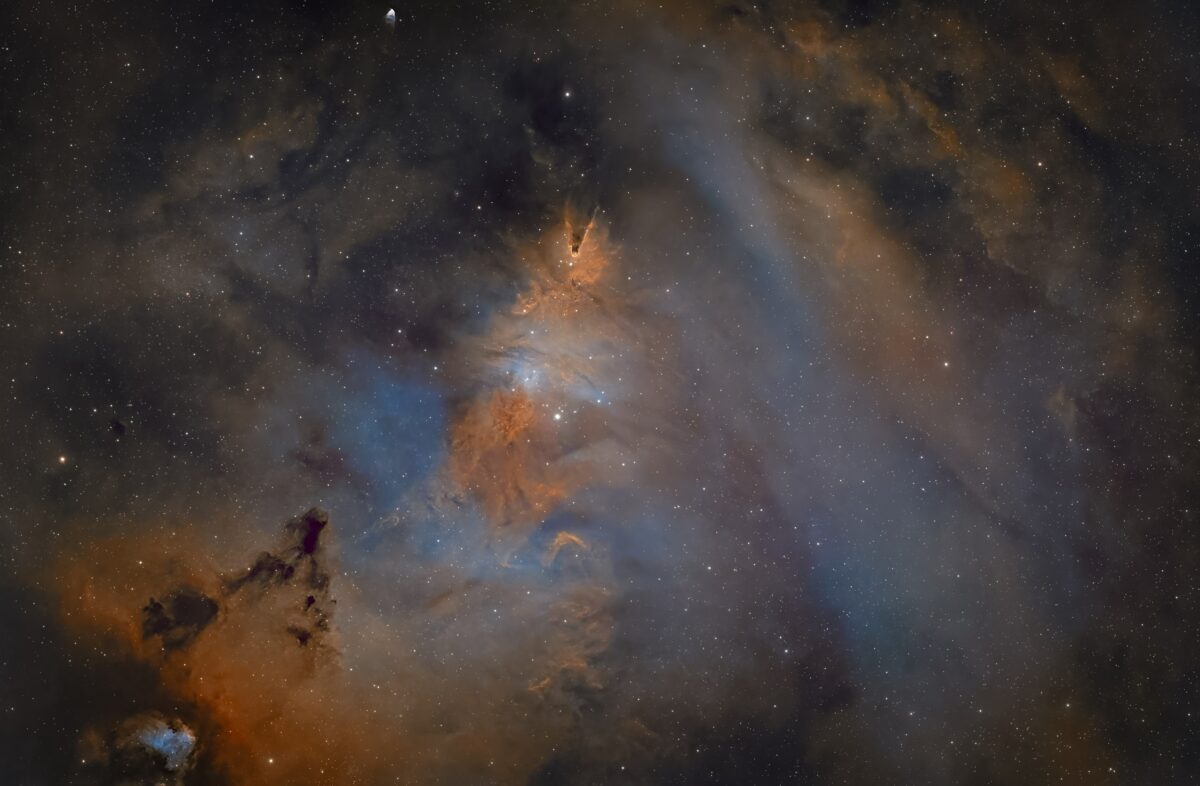
The Cone Nebula, named because of its apparent shape, lies in the southern part of NGC 2264, the northern part being the magnitude-3.9 Christmas Tree Cluster. It is in the Monoceros constellation and is about 2700 light-years from Earth. Photo: MPAS member Nik Axaris
Highlights this month
- 4SunQuadrantids meteor shower peaks (up to 110/hr). A bright 99% Moon interferes badly this year.
- 7WedVenus in superior conjunction with the Sun — lost in the glare. (3:07am)
- 9FriMars in superior conjunction with the Sun — lost in the glare. (10:30pm)
- 10SatJupiter at opposition — closest and brightest of the year, up all night in Gemini (mag −2.5). (7:36pm)
- 22ThuMercury in superior conjunction with the Sun — lost in the glare. (2:36am)
- 23FriThe Moon passes Saturn — 5° apart. (9:14pm)
This month you will find the second brightest star Canopus in the constellation Carina sitting high in the sky, while Sirius, the brightest star of the entire night sky, is almost overhead. Orion dominates the view with its brightest stars, supergiants blue-white Rigel and red Betelgeuse, also high up, and the Orion Nebula (M42) placed high within the constellation. The prominent upside down “V” shape of the Hyades open star cluster in Taurus is a fine sight to the naked eye or through binoculars, with nearby Aldebaran, the brightest star in the constellation, shining with a red-orange tint lower in the north.
The constellations best seen in January are Caelum, Dorado, Lepus, Mensa, Orion, Pictor, Reticulum and Taurus. Two of these constellations – Orion and Taurus – are quite prominent in the evening sky, while others are simply best observed at this time of year. January is the best time of year to observe a number of famous deep sky objects located in these constellations. The most popular telescope targets include the Orion Nebula (M42), the Crab Nebula (M1), the Pleiades (M45) and Hyades clusters, and the Large Magellanic Cloud (LMC). The LMC in the constellation Dorado can be seen with binoculars in the evenings. Among its sparkling stars, you will find the Tarantula Nebula (NGC 2070), which appears to the naked eye as a glowing patch the size of the full moon.
Conjunctions to look for in January, which is when two astronomical objects appear close to each other in the sky, include the moon and Jupiter on January 4, the moon and Saturn on January 23, and then the moon and Jupiter on January 31.
Throughout January, the Mornington Peninsula Astronomical Society will be holding its Summer Series public stargazing nights on Friday 2, Saturday 3, Friday 9 and Friday 16th at the MPAS Observatory at The Briars in Mount Martha. Starting at 8pm with a multimedia talk and Q&A, before moving outside to view the moon, planets, stars and clusters, all through a wide array of telescopes supplied by the society and members. Tickets are limited and bookings are necessary, so don’t miss out!
By Nerida Langcake
This article appeared in the January 2026 issue of the Mornington Peninsula Magazine.
The sky in detail — January 2026
Sun & twilight
| Date | Sunrise | Sunset | Day length | Astro. dark begins | ends |
|---|---|---|---|---|---|
| Thu 1 | 6:00am | 8:46pm | 14h 47m | 10:42pm | 4:04am |
| Sat 10 | 6:08am | 8:46pm | 14h 38m | 10:39pm | 4:15am |
| Tue 20 | 6:18am | 8:43pm | 14h 24m | 10:31pm | 4:30am |
| Sat 31 | 6:31am | 8:35pm | 14h 04m | 10:18pm | 4:48am |
Days shorten by about 43 minutes over the month.
The Moon
- Full MoonSat 3, 9:03pm
- Last QuarterSun 11, 2:52am
- New MoonMon 19, 6:52am
- First QuarterMon 26, 3:52pm
Perigee 2 Jan (360,600 km) · Apogee 14 Jan (405,500 km) · Perigee 30 Jan (365,800 km)
The planets
Rise/set for mid-month at The Briars.
| Planet | In | Mag | Rise | Transit | Set | Best |
|---|---|---|---|---|---|---|
| Mercury | Sgr | −1.0 | 5:48am | 1:13pm | 8:37pm | Hidden |
| Venus | Sgr | −3.8 | 6:21am | 1:38pm | 8:55pm | Hidden |
| Mars | Sgr | 1.2 | 6:05am | 1:24pm | 8:43pm | Hidden |
| Jupiter | Gem | −2.5 | 8:17pm | 1:08am | 5:55am | All night |
| Saturn | Psc | 1.1 | 11:22am | 5:34pm | 11:46pm | Evening |
| Uranus | Tau | 5.7 | 4:24pm | 9:22pm | 2:24am | Evening |
| Neptune | Psc | 7.9 | 11:36am | 5:42pm | 11:48pm | Evening |
Meteor showers
- Quadrantids — peaks 4 January, radiant in Boötes (up to 110/hr). Radiant stays below the horizon from Victoria — essentially a no-show this far south. A bright 99% Moon interferes badly this year.
Computed for The Briars, Mt Martha. Times are local (Melbourne).
Generated automatically from the MPAS sky engine on 20 October 2026.
The solar system — January 2026
Evening sky Morning sky Up much of the night Lost in the Sun’s glare
Open the full interactive orrery ↗ — fast-forward, pick any date, toggle the Moon and more.
Looking for an earlier month? Browse all past monthly guides →