
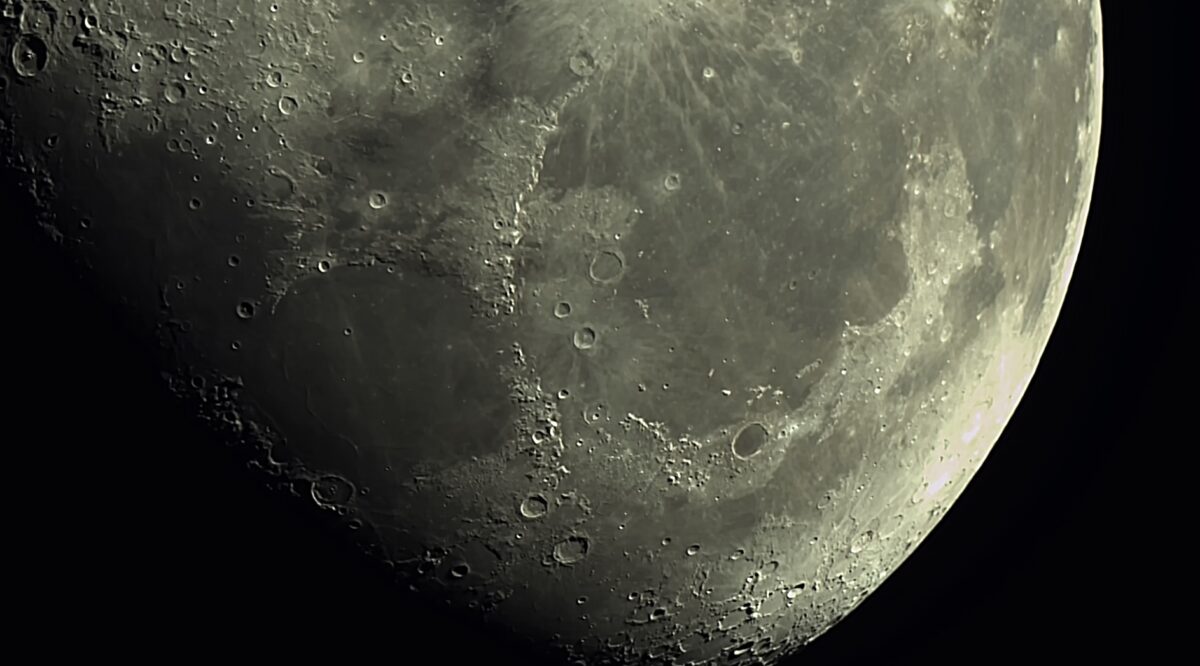
The moon is our only natural satellite, orbiting Earth at an average distance of 384,399km. The two bodies are bound by gravitational attraction, and the resulting tidal forces are the main driver of Earth’s tides and have pulled the moon to always face us with the same near side. Photo: MPAS member Leigh Hornsby
Highlights this month
- 6WedEta Aquariids meteor shower peaks (up to 50/hr). A bright 82% Moon interferes badly this year.
- 15FriMercury in superior conjunction with the Sun — lost in the glare. (12:15am)
- 15FriThe Moon passes Mars — 5° apart. (5:38am)
- 19TueThe Moon passes Venus — 5° apart. (5:47pm)
- 20WedThe Moon passes Jupiter — 5° apart. (7:48pm)
- 23SatUranus in superior conjunction with the Sun — lost in the glare. (12:50am)
The Milky Way rises high in the south this month, with Sagittarius and Scorpius sitting in the east – a clue that winter is on its way. Sitting high in the southern sky during May is the prominent constellation Crux, the Southern Cross. If you have a small telescope, be sure to point it at Crux’s brightest star Acrux, which is actually a double star made of two blue-white stars.
The large constellation Centaurus, the Centaur, sits within the stunning star fields of the Milky Way. It is home to arguably the finest globular cluster in the whole night sky: the magnificent Omega Centauri, or NGC 5139. The constellation’s two brightest stars are Alpha and Beta Centauri, known more familiarly to astronomers as Rigil Kentaurus and Hader. The constellation is fully visible between the latitudes of 25°N and 90°S. For reference, the Mornington Peninsula Astronomical Society observatory at Mount Martha is located at 38°S.
This month’s conjunctions, which is when two astronomical objects appear close to each other, include the moon and Saturn on May 14, the moon and Mars on May 15, the moon and Venus on May 19, and the moon and Jupiter on May 20. A blue moon – the second full moon in a single calendar month – is expected on May 31. This relatively rare event occurs every two or three years and usually results in 13 full moons in a year rather than 12. This year the annual Eta Aquariid meteor shower peaks on the night of May 6-7 and is caused by the dust left over from Halley’s Comet entering our atmosphere and vaporising. You can expect to see roughly 30 meteors an hour if you are very lucky. The meteors appear to be coming from a point near the star Eta Aquarii in Aquarius, and tend to be quite fast-moving. The further south you are, the better view of the shower you will get.
By Nerida Langcake
This article appeared in the May 2026 issue of the Mornington Peninsula Magazine.
The sky in detail — May 2026
Sun & twilight
| Date | Sunrise | Sunset | Day length | Astro. dark begins | ends |
|---|---|---|---|---|---|
| Fri 1 | 7:01am | 5:32pm | 10h 31m | 7:02pm | 5:32am |
| Sun 10 | 7:09am | 5:23pm | 10h 13m | 6:54pm | 5:39am |
| Wed 20 | 7:18am | 5:14pm | 9h 56m | 6:47pm | 5:46am |
| Sun 31 | 7:26am | 5:08pm | 9h 42m | 6:42pm | 5:53am |
Days shorten by about 49 minutes over the month.
The Moon
- Full MoonSat 2, 3:25am
- Last QuarterSun 10, 7:11am
- New MoonSun 17, 6:05am
- First QuarterSat 23, 9:13pm
- Full MoonSun 31, 6:46pm
Apogee 5 May (405,900 km) · Perigee 17 May (357,800 km)
The planets
Rise/set for mid-month at The Briars.
| Planet | In | Mag | Rise | Transit | Set | Best |
|---|---|---|---|---|---|---|
| Mercury | Tau | −2.2 | 7:18am | 12:18pm | 5:18pm | Hidden |
| Venus | Tau | −3.7 | 9:50am | 2:28pm | 7:06pm | Hidden |
| Mars | Psc | 1.3 | 4:58am | 10:30am | 4:02pm | Morning |
| Jupiter | Gem | −1.7 | 11:32am | 4:19pm | 9:07pm | Evening |
| Saturn | Psc | 0.8 | 3:36am | 9:31am | 3:27pm | Morning |
| Uranus | Tau | 5.8 | 7:49am | 12:44pm | 5:39pm | Hidden |
| Neptune | Psc | 7.9 | 3:03am | 9:05am | 3:06pm | Morning |
Meteor showers
- Eta Aquariids — peaks 6 May, radiant in Aquarius (up to 50/hr). Debris of Halley's Comet and one of the best showers of the year from the south — swift meteors in the pre-dawn eastern sky. A bright 82% Moon interferes badly this year.
Computed for The Briars, Mt Martha. Times are local (Melbourne).
Generated automatically from the MPAS sky engine on 19 September 2026.
The solar system — May 2026
Evening sky Morning sky Up much of the night Lost in the Sun’s glare
Open the full interactive orrery ↗ — fast-forward, pick any date, toggle the Moon and more.
Looking for an earlier month? Browse all past monthly guides →