
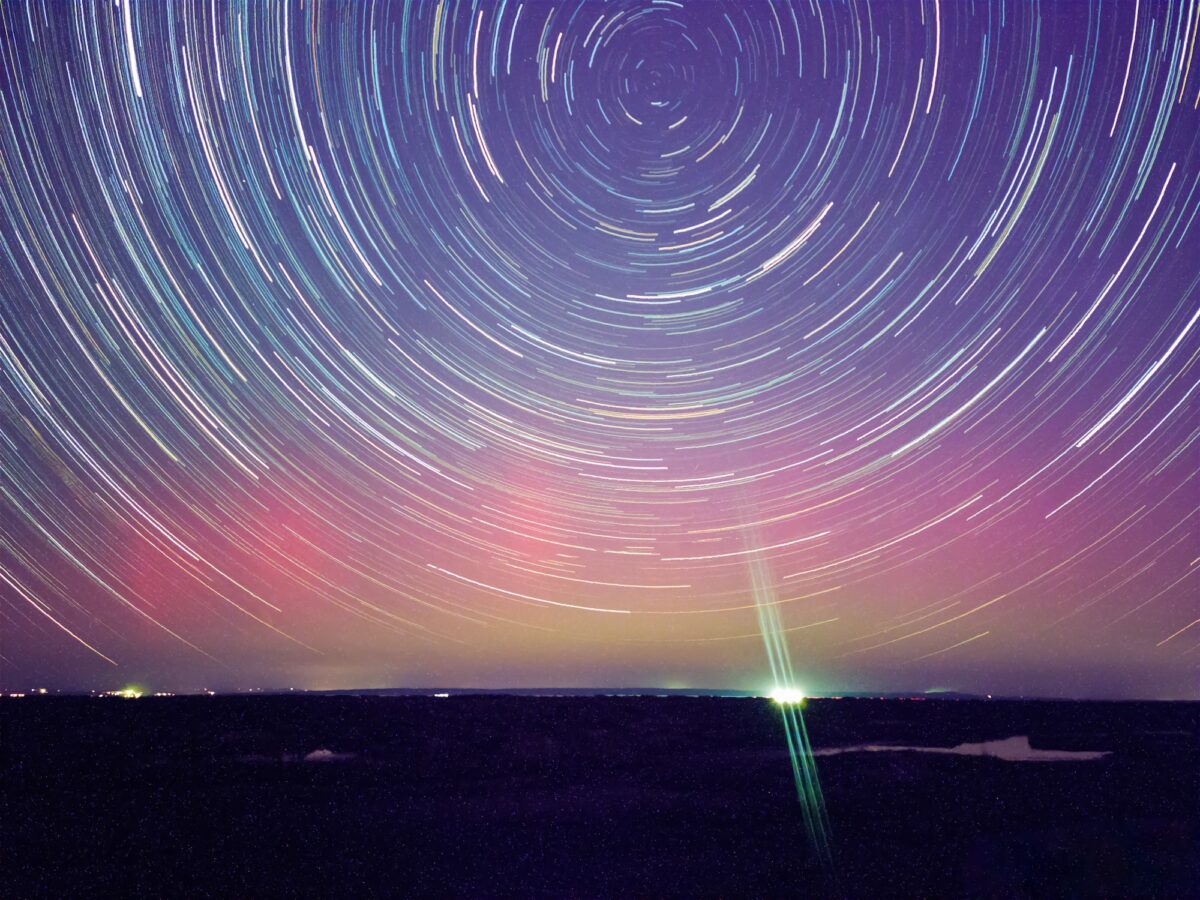
This image of the aurora and star trails was taken at Tooradin with a smartphone mounted on a tripod facing south. There were 263 20-second images using an intervalometer app at ISO1600 over two hours. Then, using another app on the phone, all the images were stacked to show the star trails. Photo: MPAS member Nerida Langcake
Highlights this month
- 4SunVenus at greatest evening elongation (45° from the Sun, mag −4.3) — best evening apparition. (8:58pm)
- 10SatThe Moon passes Saturn — 2° apart. (7:00am)
- 14WedThe Moon passes Jupiter — 4° apart. (7:05am)
- 18SunSaturn is stationary — begins retrograde (westward) motion. (11:52pm)
- 22ThuWinter solstice.
- 22ThuThe Moon passes Venus — 4° apart. (5:38pm)
- 22ThuThe Moon passes Mars — 5° apart. (8:00pm)
This month there is no shortage of interesting objects to view from southern latitudes. A good place to start is the constellation Scorpius, which contains the stunning open clusters M6 and M7. They sit not far from the Scorpion’s tail, and a pair of binoculars shows them very clearly. Scorpius’s brightest star is the orange-red Antares, which is a supergiant star with a diameter about 800 times that of our own star, the sun.
Looking south, you will be met with a rich variety of objects visible with just the naked eye, or with binoculars or a small telescope. M22 in the constellation Sagittarius is an impressive globular cluster, while the emission nebula M8, also called the Lagoon Nebula, is a fine target for binoculars. Meanwhile, Omega Centauri, arguably the finest globular cluster in the night, sits at the heart of Centaurus, the Centaur.
While there may be more impressive sights in the southern part of the June sky, there is also much to see when looking north, such as the globular clusters M13 and M92 in the constellations Hercules. There are also plenty of interesting clusters to look at in Ophiuchus. Besides the two globular clusters M10 and M12, and the open cluster NGC 6633, be sure to look out for the open cluster IC 4665. It is composed of a group of 30 stars and is a lovely sight through binoculars.
Venus will be at its greatest elongation east on June 5, which means it is at its farthest distance from the sun. This month’s conjunctions, which is when two astronomical objects appear close to each other in the sky, include the moon and Saturn on June 10, the moon and Jupiter on June 14, then the moon and Venus plus the moon and Mars on June 18. Earth is at solstice on June 22, which marks the shortest day of the year in the southern hemisphere, when we receive the least energy from the sun. On the day of the winter solstice, we are tilted as far away from the sun as possible, which means that the sun’s path across the sky is as low in the sky as it can be.
By Nerida Langcake
This article appeared in the June 2023 issue of the Mornington Peninsula Magazine.
The sky in detail — June 2023
Sun & twilight
| Date | Sunrise | Sunset | Day length | Astro. dark begins | ends |
|---|---|---|---|---|---|
| Thu 1 | 7:27am | 5:08pm | 9h 41m | 6:42pm | 5:53am |
| Sat 10 | 7:32am | 5:06pm | 9h 34m | 6:41pm | 5:58am |
| Tue 20 | 7:36am | 5:06pm | 9h 30m | 6:41pm | 6:01am |
| Fri 30 | 7:37am | 5:09pm | 9h 32m | 6:44pm | 6:03am |
Days shorten by about 9 minutes over the month.
The Moon
- Full MoonSun 4, 1:46pm
- Last QuarterSun 11, 5:35am
- New MoonSun 18, 2:38pm
- First QuarterMon 26, 5:46pm
Perigee 7 Jun (365,200 km) · Apogee 23 Jun (405,500 km)
The planets
Rise/set for mid-month at The Briars.
| Planet | In | Mag | Rise | Transit | Set | Best |
|---|---|---|---|---|---|---|
| Mercury | Tau | −0.7 | 6:07am | 11:05am | 4:03pm | Hidden |
| Venus | Cnc | −4.4 | 10:38am | 3:34pm | 8:31pm | Evening |
| Mars | Cnc | 1.7 | 10:53am | 3:58pm | 9:03pm | Evening |
| Jupiter | Ari | −1.9 | 3:43am | 9:05am | 2:27pm | Morning |
| Saturn | Aqr | 0.8 | 10:48pm | 5:26am | 12:01pm | Morning |
| Uranus | Ari | 5.9 | 4:58am | 10:02am | 3:06pm | Morning |
| Neptune | Psc | 7.9 | 12:33am | 6:41am | 12:50pm | Morning |
Computed for The Briars, Mt Martha. Times are local (Melbourne).
Generated automatically from the MPAS sky engine on 24 October 2026.
The solar system — June 2023
Evening sky Morning sky Up much of the night Lost in the Sun’s glare
Open the full interactive orrery ↗ — fast-forward, pick any date, toggle the Moon and more.
Looking for an earlier month? Browse all past monthly guides →