
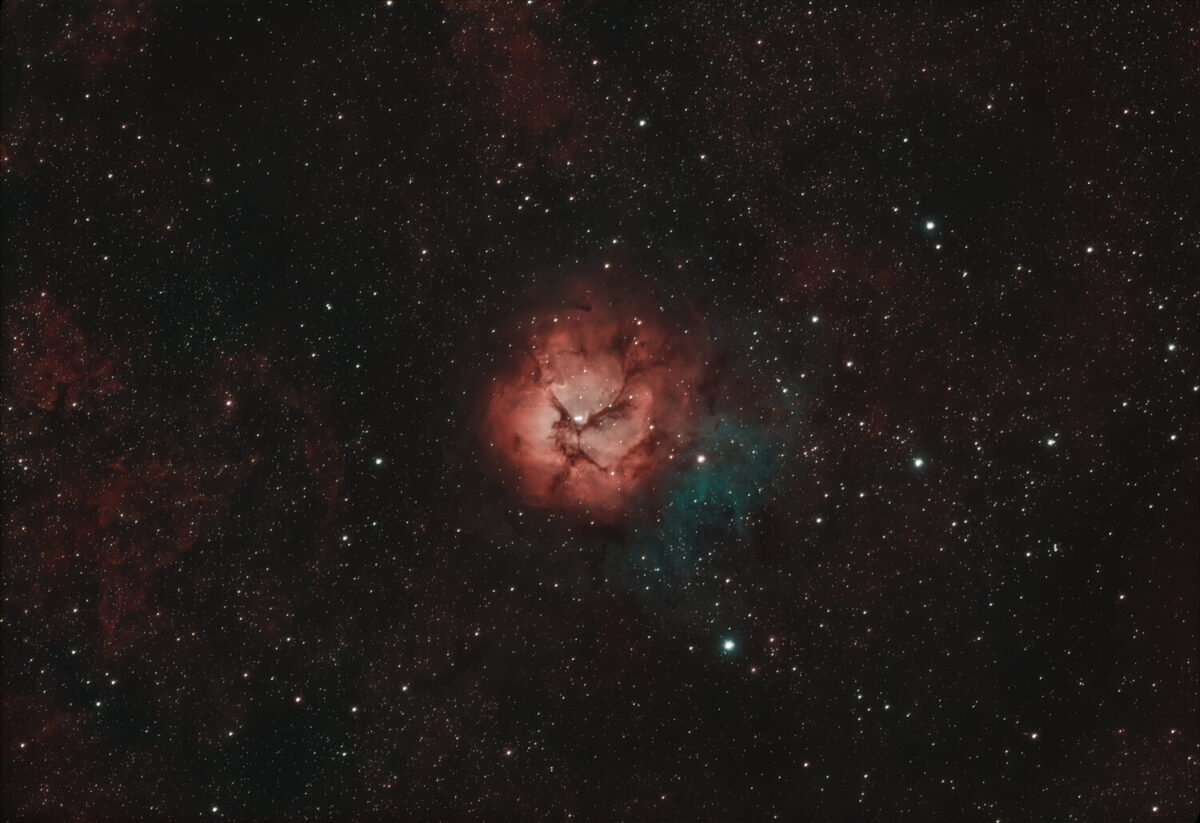
The Trifid Nebula (M20) is an unusual combination of an open cluster of stars – an emission nebula, a reflection nebula and a dark nebula. Its name means ‘divided into three lobes’. Photo by MPAS member Nik Axaris
Highlights this month
- 2SunThe Moon passes Jupiter — 3° apart. (5:37am)
- 3MonThe Moon passes Saturn — 2° apart. (12:10am)
- 9SunThe Moon passes Mars — 3° apart. (11:29pm)
- 13ThuVenus at greatest morning elongation (46° from the Sun, mag −4.3) — best morning apparition. (11:19am)
- 13ThuPerseids meteor shower peaks (up to 100/hr). A 35% Moon washes out fainter meteors for part of the night.
- 15SatUranus is stationary — begins retrograde (westward) motion. (11:36pm)
- 18TueMercury in superior conjunction with the Sun — lost in the glare. (12:56am)
- 29SatThe Moon passes Jupiter — 4° apart. (6:23pm)
- 30SunThe Moon passes Saturn — 2° apart. (4:18am)
In the August skies, you can take your pick from a superb selection of binocular and telescope targets. You will find Sagittarius, the Archer, lying almost overhead, providing a feast of objects to observe such as M17, the Omega Nebula, which is a good target for a small telescope. It is a glowing cloud of hydrogen gas resembling the Greek letter Omega (Ω). To its southwest lies Scorpius, the Scorpion.
If you have a telescope, the Lagoon Nebula makes a wonderful target in Sagittarius, and with a larger telescope with a wide enough field of view you can also glimpse the Trifid Nebula, M20. Its name means ‘divided into three lobes’. M20 is an unusual combination of an open cluster of stars – an emission nebula, a reflection nebula and a dark nebula.
Two interesting open clusters – M6 and M7 – are nestled among rich star fields in Scorpius, and both are visible to the naked eye in an average dark sky location. Looking south of Scorpius is the constellation Ara, where you will find NGC 6188 – aka the Fighting Dragons of Ara – and the bright open star cluster NGC 6193, visible to the naked eye, which is responsible for a region of reflection nebulosity within NGC 6188.
The star field M24 in Sagittarius makes a great binocular target. Looking northwards, you will find the planetary nebula M57, or the Ring Nebula. It is an interesting target for a small telescope, as is the larger planetary nebula M27, or the Dumbbell Nebula, in the constellation Vulpecula, the Fox.
On August 28, asteroid Ceres will be at opposition and can be viewed with binoculars. Ceres is the largest object in the asteroid belt between Mars and Jupiter and the only dwarf planet located in the inner solar system.
By Nerida Langcake
This article appeared in the August 2020 issue of the Mornington Peninsula Magazine.
The sky in detail — August 2020
Sun & twilight
| Date | Sunrise | Sunset | Day length | Astro. dark begins | ends |
|---|---|---|---|---|---|
| Sat 1 | 7:21am | 5:32pm | 10h 11m | 7:03pm | 5:50am |
| Mon 10 | 7:11am | 5:40pm | 10h 28m | 7:09pm | 5:42am |
| Thu 20 | 6:59am | 5:48pm | 10h 49m | 7:17pm | 5:30am |
| Mon 31 | 6:43am | 5:58pm | 11h 14m | 7:25pm | 5:16am |
Days lengthen by about 63 minutes over the month.
The Moon
- Full MoonTue 4, 1:59am
- Last QuarterWed 12, 2:42am
- New MoonWed 19, 12:47pm
- First QuarterWed 26, 3:57am
Apogee 10 Aug (405,100 km) · Perigee 21 Aug (363,200 km)
The planets
Rise/set for mid-month at The Briars.
| Planet | In | Mag | Rise | Transit | Set | Best |
|---|---|---|---|---|---|---|
| Mercury | Leo | −1.9 | 7:06am | 12:16pm | 5:27pm | Hidden |
| Venus | Gem | −4.3 | 4:18am | 9:14am | 2:10pm | Morning |
| Mars | Psc | −1.4 | 10:31pm | 4:19am | 10:04am | Morning |
| Jupiter | Sgr | −2.4 | 2:45pm | 10:04pm | 5:26am | Evening |
| Saturn | Sgr | 0.1 | 3:25pm | 10:38pm | 5:55am | Evening |
| Uranus | Ari | 5.8 | 12:04am | 5:19am | 10:34am | Morning |
| Neptune | Aqr | 7.8 | 7:50pm | 2:12am | 8:29am | Morning |
Meteor showers
- Perseids — peaks 13 August, radiant in Perseus (up to 100/hr). The famous northern shower, but its far-northern radiant scarcely rises from Victoria — only a trickle this far south. A 35% Moon washes out fainter meteors for part of the night.
Computed for The Briars, Mt Martha. Times are local (Melbourne).
Generated automatically from the MPAS sky engine on 20 September 2026.
The solar system — August 2020
Evening sky Morning sky Up much of the night Lost in the Sun’s glare
Open the full interactive orrery ↗ — fast-forward, pick any date, toggle the Moon and more.
Looking for an earlier month? Browse all past monthly guides →